

A veneer consultation is a planning visit, not a sales appointment. The dentist listens to what you want to change, examines your teeth, gums and bite, checks that veneers are the right fit, and walks you through materials, steps, risks, upkeep and cost before anything is done to a tooth. You should leave knowing whether you are a candidate, which type suits you, and what the next step is, with no pressure to book it that day.
This guide explains each part of that visit, what to bring, which questions are worth asking, and how to raise comfort concerns if the dentist’s chair makes you nervous.
TL;DR
- A good consultation covers your goals, a full exam of teeth, gums and bite, photos or scans, and an honest discussion of options, including ones that are not veneers.
- Healthy gums and teeth come first: decay and gum disease need treatment before veneers.
- Porcelain generally takes at least two visits; composite can often be done in one. Removing enamel is not reversible, so ask about preparation.
- Ask for a written plan with the materials, number of teeth, upkeep and cost. Cosmetic work is often only partly covered, if at all.
- If you are anxious, say so at the start. Comfort options and gentler tools are part of the plan, not an extra.
Table of Contents
- What a veneer consultation actually involves
- What to bring and how to prepare
- Are you a good candidate? What the dentist checks
- Porcelain, composite and no-prep: questions about materials
- Questions to ask before you say yes
- Is veneer treatment painful? Comfort and dental anxiety
- How much do veneers cost, and what shapes the estimate?
- What about the “4-8-10 rule”?
- Our perspective
- Book your veneer consultation in Calgary
- FAQ
- Sources
What a veneer consultation actually involves
Veneers are thin shells, usually porcelain or composite resin, bonded to the front of teeth. The Canadian Dental Association says they may improve stained, chipped, misshapen or slightly crooked teeth and close gaps. The consultation is where the dentist decides whether that is realistic for your mouth.
A thorough visit usually moves through these stages:
- Your goals. What bothers you when you look in the mirror or at photos? Colour, a gap, a chipped edge, tooth length, uneven edges? Bring pictures of smiles you like, and also of ones you do not.
- Health history. Medications, allergies, past dental work, grinding or clenching, and any jaw pain or headaches.
- Clinical exam. Teeth, gums, existing fillings or crowns, bite, and how your teeth meet and move. X-rays are often part of this.
- Photos, scans or impressions. These record your starting point and help the dentist plan shape and shade.
- Options discussion. Veneers, composite bonding, whitening, aligners, crowns, or a combination.
- Plan and estimate. Which teeth, which material, how many visits, and what it will cost.
One point from professional regulation is worth knowing as a patient. Ontario’s dental regulator, in a notice of a disciplinary hearing, alleges that a dentist failed to document a diagnosis, address urgent needs before aesthetic restorative work, and verify the bite and patient approval before cementation. Those are allegations in one case, but they describe the right order of work: diagnose first, treat urgent problems first, and confirm you approve the result before anything is permanently bonded. A good consultation follows that sequence.
What to bring and how to prepare
You do not need much, but a little preparation makes the visit far more useful.
- Inspiration photos. A few images of the look you want. Natural, subtle and brighter are not precise words, and photos are.
- A list of medications and health conditions.
- Dental records or X-rays from a previous clinic, if you have them. Ask the old office to send them ahead.
- Benefits information. Your plan name and policy number if you have private coverage, so the office can explain what is likely to be eligible.
- Your questions, written down. Nerves wipe memories quickly. The question list further down is a starting point.
- Any night guard, retainer or old whitening trays you already use.
It also helps to think about your timeline. If you have a wedding, graduation or photo shoot, tell the dentist early. Porcelain work involves a lab, and a realistic schedule is better than a rushed one.
Are you a good candidate? What the dentist checks
The exam decides this, and it is the most important part of the visit. According to the CDA, candidates need healthy teeth and gums, and active decay or periodontal disease must be treated before proceeding. A dentist may also suggest something other than veneers if there is not enough enamel for bonding, if a large part of the tooth is missing, or if you grind or clench.
A peer-reviewed review of veneers describes them as a conservative option for selected problems such as resistant discolouration, minor shape or size changes, gaps and small chips. It adds that severity, function, bite, soft-tissue health, tooth position, existing restorations and parafunction (habits such as grinding) must all be assessed, because any of these can rule veneers out or call for a more extensive treatment.
In plain terms, expect the dentist to look at:
| What is checked | Why it matters |
|---|---|
| Gum health | Inflamed or receding gums need care first, because veneer edges sit near the gumline |
| Decay and old fillings | Active decay must be treated before any cosmetic work |
| Enamel remaining | Bonding works best to enamel; thin enamel limits options |
| Bite and grinding | Clenching and grinding can chip or loosen veneers, so a night guard may be part of the plan |
| Tooth position and colour | Underlying colour affects which material and thickness work |
| Amount of tooth missing | A large missing portion may call for a crown instead |
If gum recession is one of your concerns, our guide to gum recession causes and treatment explains why gum health is addressed before cosmetic work.
Veneers or crowns?
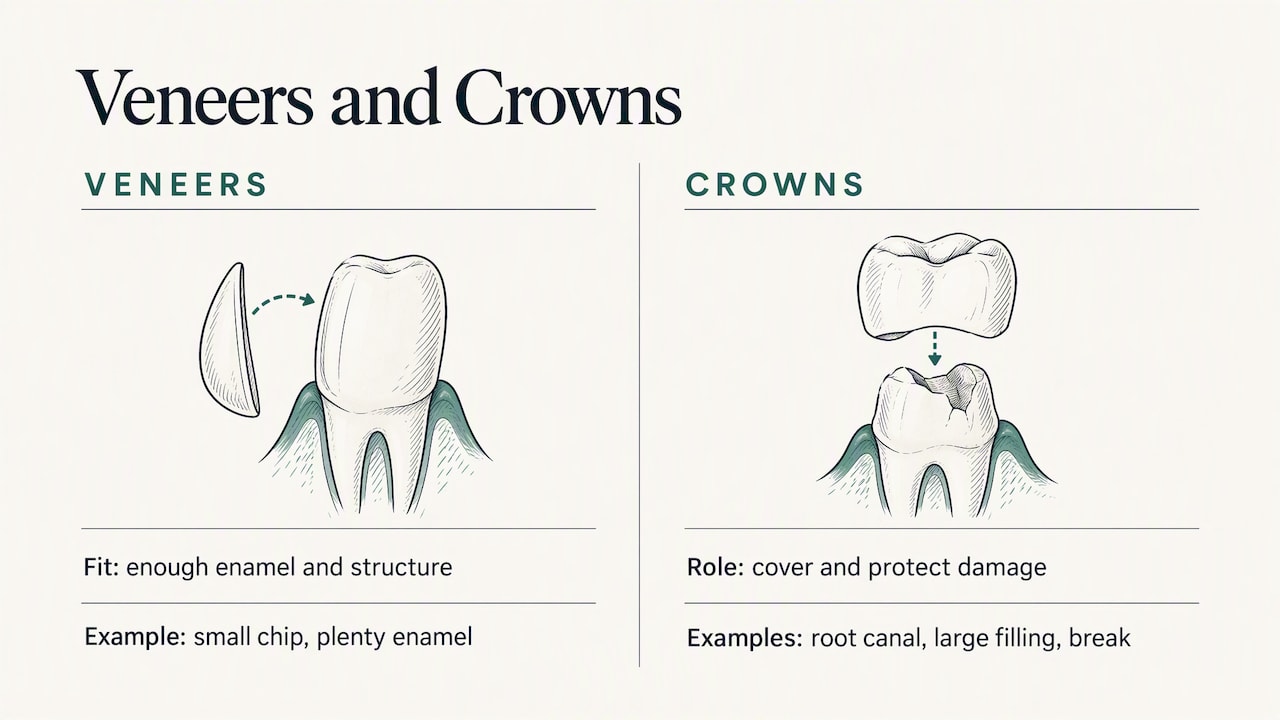
This is a common question, and the answer depends on how much natural tooth is left. The CDA says crowns cover and protect a damaged tooth and are commonly considered after root canal treatment, to support a large filling, or to repair a broken tooth. The Ontario Dental Association notes that veneers suit teeth with enough enamel and structure remaining, while a crown may be used for a broken, badly stained or decay-damaged tooth.
So a tooth with a small chip and plenty of enamel is a veneer or bonding candidate. A tooth with a big filling and a crack may need a crown. Your dentist should explain which applies to each tooth, since one smile can include both.
Other options that might fit
A JCDA clinical report says treatment planning should weigh alternatives and how much sound enamel would be removed. Thin laminate veneers may suit teeth with acceptable underlying colour and selected shape or alignment issues, while direct composite may be more conservative where tooth has been lost to erosion. For small changes, our page on composite bonding explains what it fixes and how long it lasts. If crowding is the main issue, clear aligners may move teeth without removing any enamel. If colour is the only concern, whitening may be enough.
Porcelain, composite and no-prep: questions about materials
The CDA says porcelain veneers generally need at least two dental visits and offer greater strength and stain resistance than composite resin veneers, which can often be finished in a single visit.
Here is how those choices compare in a consultation:
| Porcelain veneers | Composite veneers or bonding | No-prep veneers | |
|---|---|---|---|
| Visits | Usually two or more | Often one | Typically lab-made, so more than one |
| Stain resistance | Generally better | More prone to staining | Depends on the material |
| Enamel removal | Some, depending on the case | Little to none | Minimal to none |
| Best for | Larger changes in colour or shape | Small chips, gaps, quick changes | Suitable teeth that need little or no reshaping |
We go deeper on the lifespan of each in how long veneers last. If you are curious about the minimal-drilling approach, see our page on no-prep veneers in Calgary. Whether no-prep is appropriate depends on your tooth position and size, which only an exam can tell.
Questions to ask before you say yes
The CDA states that veneers are not reversible when enamel is removed. That makes informed consent central. In another hearing notice, Ontario’s regulator alleges a dentist failed to review treatment options, risks (including redoing existing veneers), post-treatment maintenance and costs before veneer treatment. Those four areas make a useful checklist for your own visit:
Options and fit
- Am I a good candidate, and for which teeth?
- What else could achieve my goal with less tooth removal?
Preparation
- How much enamel, if any, will be removed?
- Will I have temporary veneers while the permanent ones are made?
Materials and look
- Porcelain, composite or another material, and why?
- Can I see a preview of the shape and shade before it is made?
- What happens if I do not like the result?
Risks and aftercare
- What could go wrong, and what would the fix involve?
- Do I need a night guard?
- How often will veneers need to be replaced?
Cost and timing
- What is the total, tooth by tooth, including lab and temporaries?
- How many visits, and over how many weeks?
- Is there a charge for the consultation itself?
On long-term care, the CDA says veneered teeth still need daily brushing and flossing, and you should avoid hard objects such as ice or fingernails. Regular hygiene visits matter too, since the gums around veneers need to stay healthy.
Is veneer treatment painful? Comfort and dental anxiety
People with dental anxiety often put off a veneer consultation, so it helps to know that the first visit is mostly talking, looking and imaging. Preparing teeth for veneers, when it is needed, is done with local anesthetic, and the area is numb during the work.
Tell the team about your anxiety when you book and again at the start of the visit. Useful things to say:
- What specifically worries you: needles, noise, gagging, feeling trapped, past experiences.
- Whether you would like a signal to pause at any time.
- Whether you want each step explained beforehand, or prefer less detail.
- Whether you would like to talk about sedation for longer appointments.
Technology can help. The Ontario Dental Association’s 2018 article on anxiety in the dental office says digital scanning can remove the discomfort of traditional goop-filled impression trays, which is a real relief for anyone who gags. If this applies to you, ask whether your impressions will be taken with a scanner. Our sedation dentistry options page explains laughing gas, oral and IV sedation, so you can think about what might suit you before you come in.
How much do veneers cost, and what shapes the estimate?
Cost is the question every patient has, and the honest answer is that it depends on the number of teeth, the material, the complexity of your bite and any treatment needed first. We do not publish a flat veneer price, because a figure without an exam would mislead you. What you should receive after the consultation is a written estimate showing:
- the number of teeth treated and the material for each
- any preparatory treatment, such as gum care, fillings or a night guard
- lab fees and temporaries, if separate
- the number of visits
A few things affect the estimate directly. Porcelain and composite differ in cost and lifespan. Treating more teeth costs more, but so can a complicated bite. A smile that requires gum or bite work before veneers will have those costs added.
On insurance, cosmetic treatments are often only partly covered or not covered at all, so ask your benefits provider before you book. If you are on the Canadian Dental Care Plan, note that the Ontario Dental Association says patients may pay costs the plan does not cover, including the difference between a dentist’s usual fees and the amount covered. For how fee guides and coverage work in Alberta, see our explainer on Alberta dental fees and insurance.
Ask, too, whether the consultation is separate from the treatment fee, and whether your estimate stays valid if your plan changes after the exam.
What about the “4-8-10 rule”?
You may see a “4-8-10 rule” mentioned online in connection with veneers. We would not plan your smile around a formula. Academic guidance on smile design says a design should be functionally sound and based on careful diagnosis and analysis of the relevant factors. In practice that means your tooth proportions, lip line, gum shape, bite and face are assessed together, and the result is tailored to you. If a number or rule comes up, ask your dentist how it applies to your mouth.
Our perspective
At Vigée Dental, we think the consultation is the most important part of any veneer journey. A beautiful result starts with a clear diagnosis, not a shade chart.
Our approach is whole-body and evidence-based: we look for the root cause behind what you see in the mirror. Worn edges may point to grinding. Uneven gums may point to inflammation. Treating those first protects the veneers and your health. It also means we will sometimes recommend a smaller treatment, such as bonding or whitening, or a different order of steps, if it suits you better.
We want you to feel unhurried and free of judgment. If you are anxious, tell us, and we will build your plan around your comfort, including sedation options when they make sense. Our aim is that you understand every step, every option and every cost before you decide.
Deane
Book your veneer consultation in Calgary
If you are ready to find out what is possible for your smile, our Calgary veneers page describes porcelain and no-prep options and how we approach planning. You can also browse our wider cosmetic dentistry services, or see how veneers fit into a full smile makeover with a timeline.
At your visit, we examine your teeth, gums and bite, talk through your goals and options, and give you a plan you can take home and think about.

Contact us through our website to book.
FAQ
Is a veneer consultation free?
Policies vary from clinic to clinic, and some offices advertise free consultations while others charge an exam fee. Ask when you book what is included and whether the fee is applied to treatment. Our website is the place to confirm current arrangements at Vigée Dental.
How long does a veneer consultation take?
Plan for a longer appointment than a routine checkup, since it includes an exam, imaging, discussion of your goals and a review of options and costs. Allow time for questions, and do not hesitate to ask for a second visit if you want to think it over.
Can I get veneers on the same day?
Composite veneers can often be finished in one visit, according to the CDA. Porcelain veneers generally need at least two visits because they are made in a lab. Your dentist can tell you which is realistic for your teeth.
Are veneers cheaper than crowns?
Not necessarily, and they are not interchangeable. A veneer covers the front of a tooth with enough healthy structure, while a crown covers and protects a damaged tooth. The right choice is based on the condition of the tooth, so ask for both estimates if your dentist considers either appropriate.
What if I am nervous about the consultation?
Say so when you book. The first visit is mainly an exam and a conversation, and you can ask for steps to be explained, for breaks, and for information about sedation for later treatment.
Sources
- Canadian Dental Association: Bonding and veneers
- Canadian Dental Association: Bonding and veneers (patient guide)
- Canadian Dental Association: Crowns
- Ontario Dental Association: Cosmetic dentistry
- Ontario Dental Association: Canadian Dental Care Plan FAQ
- Ontario Dental Association: Overcoming anxiety in the dental office
- Advances in dental veneers: materials, applications and techniques
- JCDA: Esthetic rehabilitation of anterior teeth with porcelain laminate veneers
- Principles of smile design
- RCDSO notice of hearing (diagnosis and approval before cementation)
- RCDSO notice of hearing (informed consent for veneers)
Recommended
- Dental Veneers Calgary | Porcelain & No-Prep
- No-Prep Veneers Calgary | Minimal Drilling
- Cosmetic Dentistry In Calgary: Your Complete Guide
- Clear Aligners in Calgary: How They Work and Who They Suit
- Smile Makeover in Calgary: Options, Steps and Timeline
- Dental Bonding in Calgary: What It Fixes and Who It Suits