

The best dentist for you is the one you trust, who explains each step and fee before treating you, and whose hours fit your week. That matches what the Government of Alberta advises patients to weigh. At Vigée Dental, Dr. Nicole Robins built the clinic around a whole-body, judgment-free approach, with preventive care, cosmetic work such as veneers, and sedation options for anxious patients. Below is how to judge any Calgary dental office, what to expect from each type of care, and where we fit.
TL;DR
- Choose on comfort, clear answers, upfront fees and practical access, the criteria the Government of Alberta lists for patients.
- Most adults should see a dentist once or twice a year, but the right schedule depends on your own gum health, cavity history and habits.
- Veneers are cosmetic, permanent and usually not covered by benefit plans, so ask for a written plan and fee before starting.
- If dental fear keeps you away, a dentist who listens and offers sedation can change the experience entirely.
- Alberta’s fee guide is a recommendation only, so every office sets its own fees and you can ask about them first.
Table of Contents
- What to look for in a Calgary dentist
- How often you should go, and what preventive care involves
- If dental anxiety has kept you away
- Veneers: who they suit and what to ask
- What dental care costs in Alberta
- Promo: Book a first visit with Vigée Dental
- Perspective
- FAQ
- Sources
What to look for in a Calgary dentist
People searching for a dentist in the southeast usually want convenience first. That is reasonable, and the province agrees that an accessible location and hours matter. But the Government of Alberta puts other things alongside it: whether you feel comfortable with the dentist, whether you trust their abilities, and whether they answer questions, explain procedures and discuss fees. Those are the things that decide whether you keep coming back.
A practical way to apply this on a first visit:
- Notice how the conversation goes. Does the dentist explain what they see and why they recommend it, or just list work?
- Ask for fees for specific procedures before you agree. Alberta says you have the right to ask, to request rates for particular procedures and to shop around.
- Check how the office handles insurance. The province suggests asking your dentist to send a pre-authorization to your insurer so you know what is covered before treatment.
- Look at the calendar. Early, late or weekend slots matter less than whether you can actually fit a recurring visit into your routine.
- Pay attention to how you feel afterward. If you left rushed or judged, that is information.
The southeast is a big part of the city, and commuting from one end to another is part of the cost of a visit. Think about whether the office is easy to reach from home or work, then weigh that against the points above. A close office you dread is one you will skip.
How often you should go, and what preventive care involves
Prevention is where most adults get the most value from a dentist. Alberta Health Services advises brushing twice a day with a soft-bristled brush and fluoride toothpaste, flossing at least once a day, replacing your toothbrush every three to four months and attending regular checkups and cleanings. It notes that many people should see a dentist once or twice a year. At a visit, the dentist checks for decay, gingivitis and other problems, and the hygienist removes tartar, which brushing cannot remove. X-rays and fluoride may be recommended.
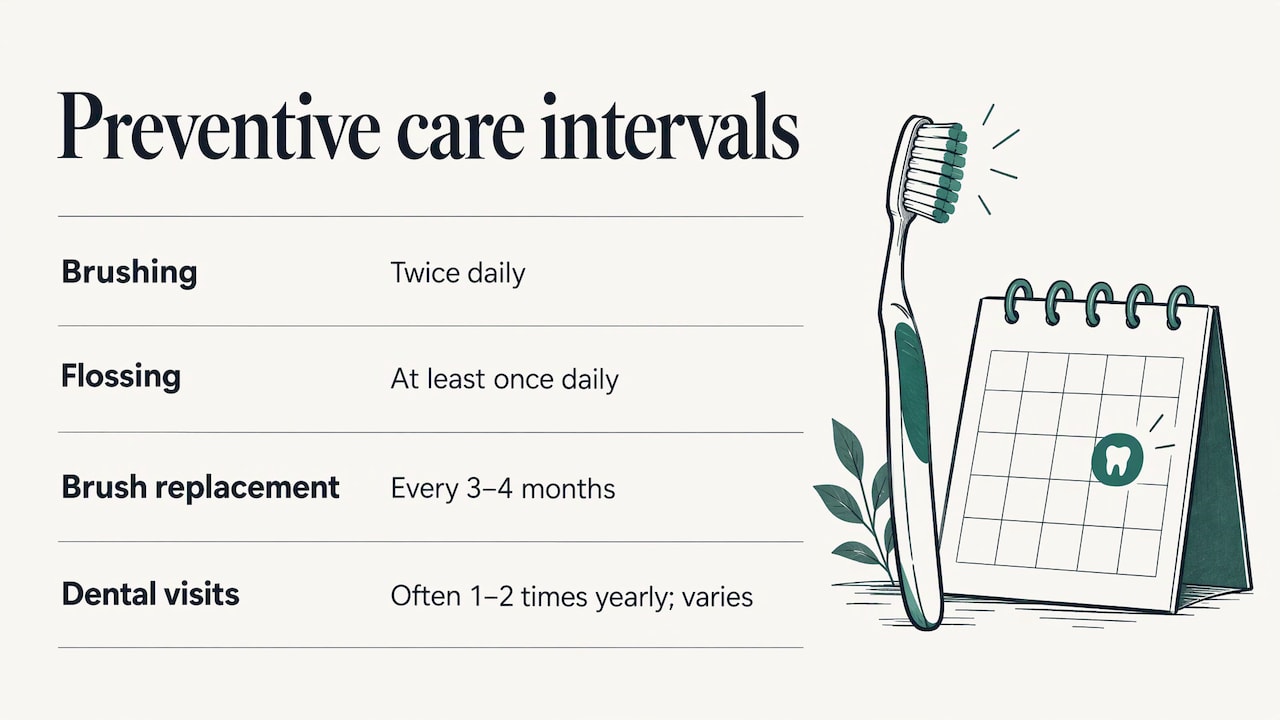
The Canadian Dental Association says the right interval is individual. Every six months is common, but how fast tartar builds up, your cavity and gum disease history, smoking, diet and overall health should set the schedule. It also cautions against deciding how often to go based on what your dental plan covers.
That individual approach is how we think about proactive dentistry: looking for the root causes of problems rather than only treating symptoms once they hurt. Our dental hygiene and teeth cleanings are part of that, and our wider preventive and proactive care covers checkups, oral cancer screening, deep cleaning for gum health, fresh breath solutions and sensitive teeth treatments.
If you are new to us, the starting point is a new patient exam. Come with your questions about gum health, sensitivity, breath or whiteness, and leave with a plan for how often you should return.
When a deeper clean is the right step
Sometimes a standard cleaning is not enough, for example when gums are inflamed and tartar has built up below the gumline. Our scaling and root planing guide explains the steps and recovery of a deep cleaning. Catching gum problems early is also one of the main reasons to keep regular appointments.
Pain, a cracked tooth or a lost filling
Dental problems rarely wait for a convenient moment. If you have sudden pain, swelling or a broken tooth, see our page on emergency dentistry in Calgary. If a tooth needs more than a filling, our root canal therapy and signs you need a root canal pages explain what to expect.
If dental anxiety has kept you away
Dental fear is common, and it tends to grow the longer you avoid care. Alberta Health Services lists typical causes: a past painful experience, feeling out of control, embarrassment, media portrayals and fear of the unknown. Its suggestions are practical, and any good office should welcome them:
- Tell your dentist about your fears at the start.
- Ask what will happen and why, before it happens.
- Book a time when you won’t be rushed.
- Use headphones and music.
- Agree on a hand signal to pause.
- Use relaxation techniques you already know.
The same page says that if a dentist is not listening or making an effort to ease your anxiety, it is fine to switch dentists. That is a fair standard, and it is the one we hold ourselves to: a personalized, judgment-free visit where your comfort sets the pace.
For some people, conversation alone is not enough. Our sedation dentistry page covers the types, safety and what to expect. In Alberta, sedation in non-hospital dental practice is governed by the College of Dental Surgeons of Alberta’s Standard of Practice, which sets equipment, personnel and training requirements and requires certain unforeseen events to be reported to the College’s CEO, as described in its 2023 annual report. Tell us about your health history and any medications before a sedation visit so the plan fits you.
Jaw tension and clenching also add to dental discomfort for many people. Dentistry increasingly uses Botox for some of these concerns, and this overview of Botox in dentistry explains the idea. We offer TMJ and masseter Botox and other Botox treatments for therapeutic and cosmetic purposes.
Veneers: who they suit and what to ask
If you are searching for a dentist because you want a different smile, veneers are likely on your list. The Canadian Dental Association describes them as thin shells bonded to the front of teeth, suited to stained, chipped or misshapen teeth, small gaps and slight misalignment.
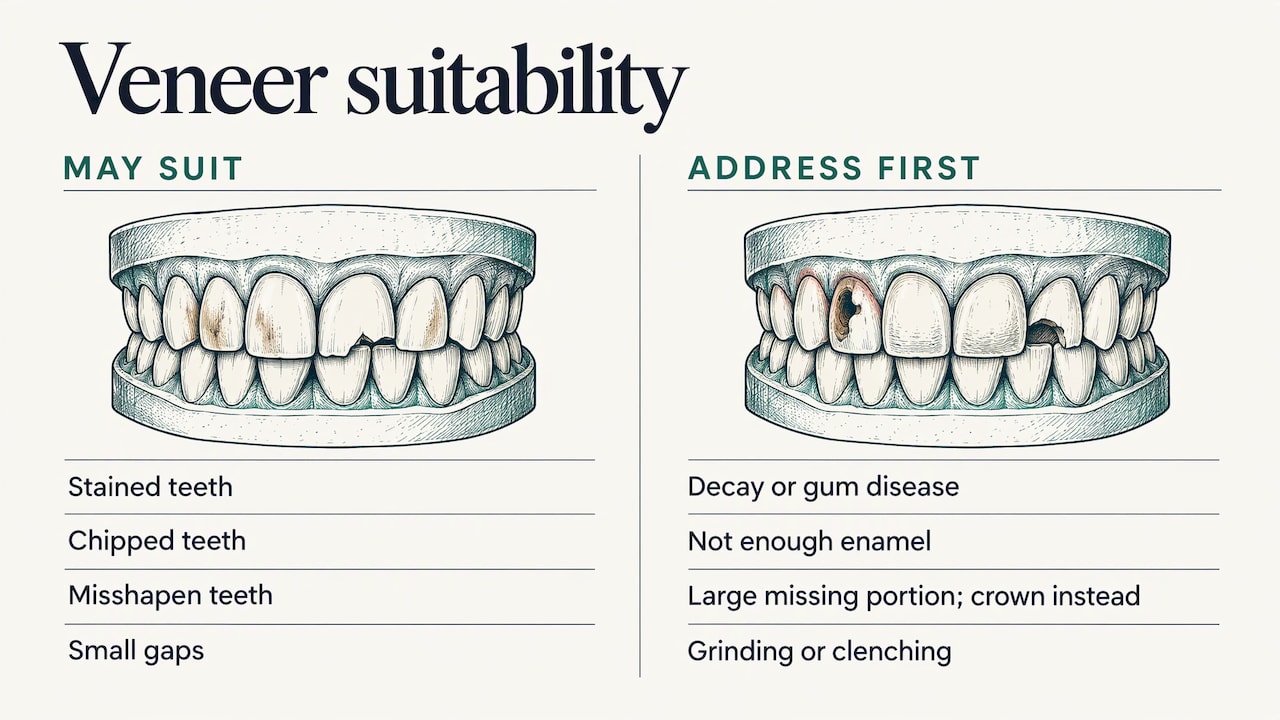
The same page names who is not a candidate until something else is addressed: teeth with decay or gum disease, teeth without enough enamel, teeth with a large missing portion (a crown is used instead), and people who grind or clench. That last point is worth raising early, because grinding is common and affects how a veneer plan is built.
What the process looks like
| Porcelain veneers | Composite veneers | |
|---|---|---|
| Visits | At least two | Can be done in one |
| Tooth preparation | A thin layer of enamel is removed | Varies by case |
| Steps | Moulding, temporaries, then custom veneers bonded at a follow-up | Built directly on the tooth |
| Reversible | No | Check with your dentist |
The Canadian Dental Association notes that porcelain veneers are not reversible, that they need daily brushing and flossing, and that you should avoid biting hard objects. We also offer no-prep veneers with minimal drilling for patients who want the least intervention. Our veneers page shows both approaches, and First Look lets you preview veneers on your own smile before you decide.
Questions for the consultation
- Are my teeth and gums healthy enough for veneers now?
- Do I grind or clench, and how will that be managed?
- Which type suits my goals, and why?
- What is the full fee, in writing, including follow-up visits?
- How long will they last and how should I care for them? Our guide to how long veneers last compares porcelain and composite.
Our veneer consultation page lists what to expect and what to ask. If you would like other cosmetic options, we also provide teeth whitening and clear aligners, and full-mouth rehabilitation for those who need restorative and cosmetic work together.
What dental care costs in Alberta
Alberta dentists set their own fees. The provincial fee guide is a recommendation, not a requirement, which is why the government encourages you to ask about fees before treatment and compare. We explain how this affects a bill in our guides to the Alberta dental fee guide and dental fees and insurance.
A few things are useful to know:
- Veneers are largely a private expense. The CDA says they are often not covered by dental benefit plans. One 2026 Canadian pricing review puts composite veneers at roughly $250 to $1,500 per tooth and porcelain at $900 to $2,500 per tooth, and says the federal plan does not cover them. Treat these as a wide range, and get a written quote for your own mouth.
- Federal coverage may apply to other care. Health Canada’s 2024-2025 Canadian Dental Care Plan report says the plan helps residents with adjusted family net income below $90,000 who have no private dental insurance. Covered services include cleanings, x-rays, fillings, root canals, non-surgical gum treatment and sedation, with co-payments for some income tiers.
- Policy can change. Federal notes from December 2025 say Alberta has signaled an intention to opt out of the plan, while Health Canada remains open to discussions. Check the official notes and the Canadian Dental Care Plan site for what applies to you now.
- Ask for pre-authorization. The Alberta government recommends it for insured patients, so you know what your insurer will pay before you start.
We do not publish prices for our services here, because the right plan and fee depend on your mouth and goals. Ask us for a written estimate at your new patient exam.
Promo: Book a first visit with Vigée Dental
If you want a Calgary dentist who explains the plan, respects your comfort and treats the cause rather than just the symptom, start with a new patient exam at Vigée Dental. We offer preventive care, cosmetic dentistry including veneers, sedation dentistry, emergency care, restorative work and pediatric dentistry for the whole family. See everything on our website and book from there.

Families can also see our pediatric dentistry page, which covers checkups, cleanings, sealants, white fillings, sports mouthguards and gentle behaviour management.
Perspective
Most people choose a dentist the way they choose a mechanic: when something is already wrong. We would rather you arrived while things are going well.
Our approach is whole-body and evidence-based. A worn tooth, bleeding gums or a sore jaw is usually telling you something about habits, health or bite, and we want to find that cause instead of repairing the same problem every year.
Comfort is part of care, not a bonus. If you are nervous, we want to hear it at the start, and we have sedation options available. Nobody here should feel judged for how long it has been.
For smile goals, we believe in showing you what is possible before you commit, and in explaining fees in plain terms. A cosmetic result should look natural and rest on healthy teeth and gums.
Deane
FAQ
How often should I see a dentist in Calgary?
Many adults go once or twice a year, according to Alberta Health Services. The Canadian Dental Association says your own gum health, cavity history, smoking, diet and general health should set the interval. At your new patient exam we will recommend a schedule that fits you.
Does the Canadian Dental Care Plan cover veneers?
No. Veneers are cosmetic, and a 2026 pricing review states the plan does not cover them at any income tier. The plan does cover services such as cleanings, fillings and root canals for eligible residents, so it is worth checking your eligibility for your preventive and restorative care.
Is sedation available if I am afraid of the dentist?
Yes, we offer sedation dentistry for patients with dental anxiety. Sedation in non-hospital dental practice in Alberta follows the College of Dental Surgeons of Alberta’s standard. Share your fears and health history when you book so we can plan the visit around you.
Do all Alberta dentists charge the same fees?
No. The Alberta fee guide is a recommendation, and dentists set their own fees. You have the right to ask about fees for specific procedures before treatment, and to ask your dentist to send a pre-authorization to your insurer.
Sources
- Dental fees in Alberta, Government of Alberta
- Basic Dental Care, Alberta Health Services
- Dental Care FAQs, Canadian Dental Association
- Dental Anxiety, Alberta Health Services
- Annual Report 2023, College of Dental Surgeons of Alberta
- Bonding & Veneers, Canadian Dental Association
- Canadian Dental Care Plan Annual Report 2024-2025, Health Canada
- Question Period Notes, December 2025, Government of Canada
- Veneers Cost in Canada 2026
- Botox in Dentistry: An Emerging Application
Recommended
- Family Dentist In Calgary: How To Choose The Right One
- Proactive Dentistry In Calgary
- Teeth Cleanings & Dental Hygiene In Calgary
- Oral Health and Overall Health: How Your Mouth and Body Are Connected
- Botox for Migraines in Calgary: Who Qualifies and What to Expect
- Judgment-Free Dentist in Calgary: What It Really Means