
The Alberta dental fee guide is a suggested price list that the Alberta Dental Association publishes each year. It is not a rule. Every dentist sets their own fees and may charge above or below it, so the guide tells you what a typical visit might cost, and your written estimate tells you what you will pay. We wrote this page so Calgary patients can read the guide with confidence and arrive at an appointment knowing what to ask. For our own version of this topic, see our Alberta dental fee guide explained for patients.
TL;DR
- The guide is a suggested-fee reference for dentists, effective January 1 to December 31, 2026. It is not mandatory.
- Sample 2026 guide fees: polishing $77.75 per 15 minutes, scaling $87.25 per 15-minute unit, fluoride $37.65, and a two-surface tooth-coloured filling $268.75.
- Insurance plans may pay by the guide, by an insurer’s own schedule or by “usual and customary” fees, so a gap can remain after reimbursement.
- Ask for a written estimate and a pre-authorization from your insurer before you agree to treatment.
- Cosmetic work such as veneers is usually quoted individually, so a consultation is the way to get a real number.
Table of Contents
- What the Alberta dental fee guide is
- Do dentists have to follow it?
- 2026 guide fees for common procedures
- How insurance uses the fee guide
- What to check in a written estimate
- Why the guide cannot price cosmetic work
- Booking a visit with clear numbers
- FAQ
- Sources
What the Alberta dental fee guide is
The guide is a reference that contains procedure descriptions, dentist billing codes and suggested fees. The Alberta government describes it as reviewed annually. The Alberta Dental Association develops it and says its purpose is to provide information and transparency.
The association also produces an abbreviated 2026 guide for general dentists. It covers preventive, diagnostic, restorative, endodontic (root canal), periodontal (gum), prosthodontic (crowns and dentures), surgical, orthodontic and adjunctive services. It applies from January 1 to December 31, 2026, and a new edition follows each year, so always check the year on the page you are reading.
The full guide is a members’ tool for dentists. The abbreviated version is the one written for patients, and it states that it may not cover your specific treatment needs or the actual cost of your care.
Do dentists have to follow it?
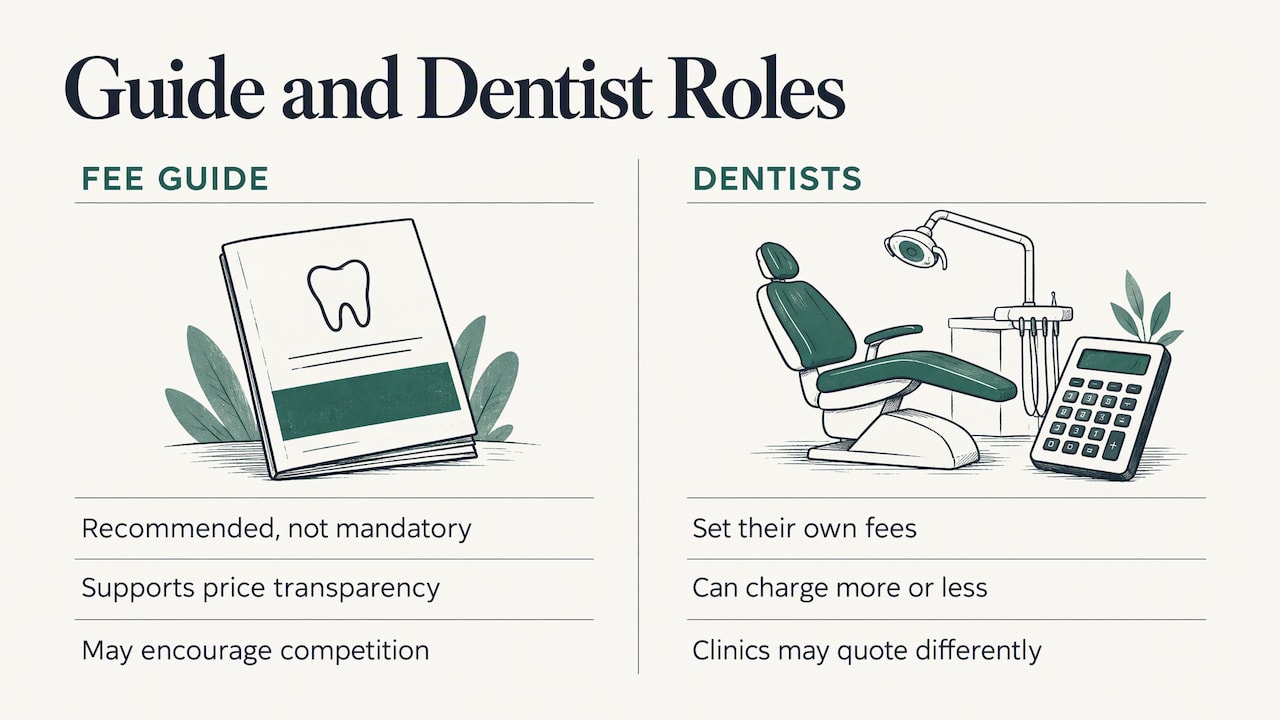
No. The Alberta government states that the amounts are recommended, not mandatory. Dentists set their own fees and can charge more or less than the guide.
The government’s view is that publishing suggested fees improves transparency, encourages competition and can help restrain costs over time, while dentists keep the ability to set their own prices. For you, that means two clinics can quote different amounts for the same filling, and both can be legitimate. Differences often come from time set aside for the visit, materials, technology and how much care goes into comfort.
2026 guide fees for common procedures
These figures come from the 2026 abbreviated guide. Treat them as reference points, not quotes.
| Procedure | 2026 suggested fee |
|---|---|
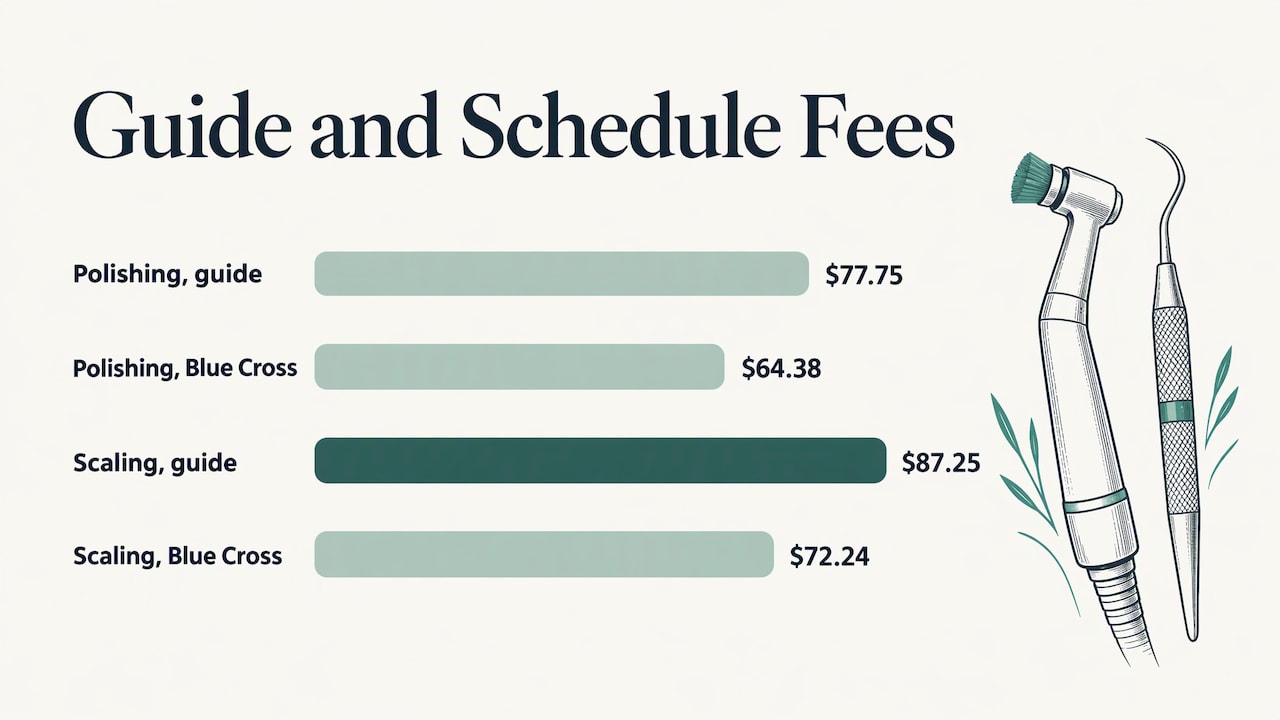
| Polishing, 15 minutes | $77.75 |
| Scaling, one 15-minute unit | $87.25 |
| Fluoride | $37.65 |
| Sealant, single tooth | $42.40 |
| Tooth-coloured filling, two surfaces, permanent molar | $268.75 |
| Porcelain-fused-to-metal crown | $1,072.55 |
Source: Alberta Dental Association, 2026.
A worked example
A routine cleaning is billed by time. If your hygienist needs one 15-minute scaling unit and 15 minutes of polishing, the guide fees add up to $87.25 plus $77.75, which is $165.00. Add fluoride at $37.65 and the total is $202.65, before any exam or X-rays. A longer cleaning uses more units, so your own number depends on how much time your mouth needs. Our page on dental cleaning cost in Calgary goes deeper on that.
How insurance uses the fee guide
Insurance is where most surprise bills come from. According to Alberta Blue Cross, plans may reimburse using provincial fee guides, the Alberta Blue Cross Dental Schedule, usual and customary fees or an individual-products usual and customary list. Dentists charge varying prices, so the plan’s rate and your dentist’s fee may not match.
The 2026 Alberta Blue Cross schedule shows how far apart those numbers can be. It lists a recall exam at $67.11, a complete exam at $119.11, polishing at $64.38 and one scaling unit at $72.24. Compare that with the guide’s $77.75 for polishing and $87.25 for scaling. If your plan pays by its own schedule and your dentist charges by the guide, you cover the difference.
One recent change is worth knowing. Alberta Blue Cross says that from February 1, 2026, a memorandum of understanding raised fees on its low-income health benefit schedules for general dentists and specialists by up to 55% of the January 1, 2026 suggested guide rate. Fees already above that did not change, and denturist and hygienist schedules were not changed at that time. This applies to those specific government-linked plans, not to every employer plan.
Annual limits matter too. Even when a fee matches your plan, you can run out of yearly coverage. A guide to dental annual maximums explains how that cap works and how to spread treatment across a plan year.
What to check in a written estimate
The Alberta government suggests asking these questions before you agree to work:
- What is recommended and why? You should understand the reason for each procedure.
- What are the fees? Ask for each item priced separately.
- Does the office follow the guide? Compare its fees with the guide year in force.
- Are there extra fees? X-rays and lab work are common additions.
- What will insurance cover? Ask the office to send a pre-authorization to your insurer.
- What is left for you? Ask your insurer which amount will be covered and what you must pay.
Alberta Blue Cross gives the same advice: ask how the office’s fees compare with the schedule and get a predetermination before treatment so you see what the plan pays and what remains. The pre-authorization takes time, so book the estimate visit a few weeks ahead of any non-urgent work.
Why the guide cannot price cosmetic work
The abbreviated guide lists common general procedures. Veneers, whitening, clear aligners and smile design depend on how many teeth are involved, the materials and the result you want, so they rarely fit a single line. The sensible way to get a number is a consultation and a written plan. For veneers, our page on what to expect at a veneer consultation walks through the questions to bring, and First Look lets you preview veneers on your smile.
Most cosmetic treatment is also elective, so insurers often cover little or none of it. Ask your plan before you plan the budget.
Our view on fee guides
A fee guide is a useful map, but a price on its own does not tell you what you are getting. We think the better question is what a visit includes and whether the plan addresses the cause of a problem. At Vigée Dental, Dr. Nicole Robins built the clinic around a whole-body, evidence-based approach that looks for root causes instead of only treating symptoms. That is why we favour proactive care: catching a small issue early is how patients keep treatment simple.
We also believe you should never feel rushed or judged when you ask about cost. Our team explains treatment options and the plan before work begins, and for patients who feel anxious we offer sedation dentistry so that a necessary visit is a comfortable one.
Deane
Booking a visit with clear numbers
If you are choosing a dentist in Calgary, start with a new patient exam. We offer proactive dentistry and dental hygiene and teeth cleanings, along with cosmetic, restorative, emergency and pediatric care. You can see everything on our main site, and if you are weighing a smile makeover, our cosmetic dentistry page is the place to start.
Bring your insurance details to the first visit. We can talk through your options, the cost of each and how your plan may apply, so the number on your estimate is no surprise.
FAQ
Is the Alberta dental fee guide mandatory?
No. The Alberta government states that the guide is a recommendation. Dentists set their own fees and may charge above or below it.
Why is my dentist’s bill different from what insurance paid?
Your plan may reimburse using its own schedule, usual and customary fees or a provincial guide. If the dentist’s fee is higher, you pay the difference. A predetermination from your insurer before treatment shows the gap in advance.
How often does the guide change?
The Alberta government says the guide is reviewed annually. The 2026 abbreviated edition applies January 1 to December 31, 2026, so check the year before you compare numbers.
Can I find the price of veneers in the guide?
The abbreviated general-dentist guide covers common procedures and may not reflect your treatment. Veneer cost depends on the number of teeth and materials, so a consultation and written plan give you a real figure.
Sources
- Dental fees in Alberta, Alberta.ca
- Abbreviated Alberta Dental Fee Guide for General Dentists, 2026
- About Us, Alberta Dental Association
- Dental benefits, Alberta Blue Cross
- 2026 ABCDS Plan Member Dental Schedule
- Frequently asked questions, Alberta Blue Cross dental compliance changes
- Dental annual maximum guide