

Full-mouth rehabilitation is a customized treatment plan that restores the health, function and appearance of most or all of your teeth, working on the gums, the bite and the jaw joints together rather than one tooth at a time. It suits people whose teeth are worn, broken, missing, decayed or failing in several places at once. This guide explains what the term means, how a dentist decides whether you need it, what treatments can be combined, and how to care for the result. If you are in Calgary, you can also see how we approach full-mouth rehabilitation.
TL;DR
- Full-mouth rehabilitation is one coordinated plan for the teeth, gums, bite, muscles and jaw joints, not a single procedure.
- It is usually considered when problems are spread across the mouth: heavy wear, multiple failing restorations, missing teeth, or bite and jaw problems.
- The plan starts with a comprehensive exam, and a good plan is sequenced, explained in writing and agreed to with informed consent.
- Gum health is stabilized first, then restorations are placed in a planned order, often with a trial phase to preview the result.
- Restorations last longer with daily care and regular professional maintenance.
Table of Contents
- What full-mouth rehabilitation means
- Signs you may need it
- How the assessment and treatment plan work
- Treatments that may be combined, and in what order
- The bite, the jaw joints and the muscles
- What to expect during treatment and recovery
- Protecting the result for the long term
- Considering full-mouth rehabilitation in Calgary
- FAQ
- Sources
What full-mouth rehabilitation means
The phrase covers a lot of ground, so it helps to start with a clinical definition. A 2025 review describes it as individualized treatment that reconstructs and restores the dentition to optimize the health of the teeth, gums, bite and the wider chewing system. Its stated objectives are optimum oral health, efficient function, comfort and aesthetics. Notice that appearance is one goal among four.
Another 2025 systematic review frames it as comprehensive treatment for severely compromised or partially missing dentitions, using fixed prostheses supported by natural teeth, implants or both to restore aesthetics, function and oral health.
You will also hear “full-mouth reconstruction” and “smile rehabilitation”. Dentists use them loosely and often interchangeably. What matters is not the label but whether your plan covers the whole system: teeth, gums, bite, muscles and joints.
It does not always mean every tooth is crowned. In many cases only the damaged teeth are restored, and healthy structure is kept wherever possible. The word “full” refers to how broadly the plan is thought through, not to how many teeth are touched.
Signs you may need it
No single symptom decides this, and only an examination can tell you. But a few patterns commonly lead a dentist to talk about a whole-mouth plan instead of fixing one tooth at a time:
- Teeth that look shorter, flatter or chipped. Years of grinding or clenching, or acid wear, can shorten teeth and change how your bite fits together.
- Several old fillings, crowns or bridges breaking down. When many restorations are near the end of their life at once, replacing them one by one can mean repeated visits and a bite that keeps shifting.
- Missing or badly damaged teeth. Gaps change how the remaining teeth carry the chewing load.
- Sensitivity or pain when chewing. This can come from decay, cracks, gum disease or a bite that puts too much force on certain teeth.
- Jaw soreness, clicking or tension headaches. These can be linked to clenching, grinding or a bite imbalance, and a dentist will check jaw-joint function as part of an exam.
- Loose teeth or bleeding, inflamed gums. Gum disease has to be treated before restorative work can succeed.
The Canadian Dental Association lists many of these same findings as things a comprehensive dental exam looks for: damaged, missing or decayed teeth, gum inflammation, the condition of existing restorations, tooth position and bite, clenching or grinding, jaw-joint function, and the condition of the facial and jaw bones.
If two or three of the patterns above sound like you, a consultation is a sensible next step. If you are anxious about the visit, that is worth saying at the start. Sedation can be part of your care plan, and a clinic that works with anxious patients will plan appointments around your comfort.
How the assessment and treatment plan work
A good plan starts with a thorough look, not a sales conversation. Expect the dentist to review your medical history and examine your teeth, gums, past dental work, tooth position and bite, signs of clenching or grinding, jaw-joint function and the bone around your face and jaw. The CDA notes that X-rays may be taken if necessary.
The gum assessment matters more than many patients expect. The University of Toronto’s Faculty of Dentistry explains that it includes a visual exam, probing for pockets and recession, recording bleeding, and checking the bite and restorations, and it also covers whether implants would be suitable. Restorations placed on unhealthy gums rarely last, which is why this step comes first.
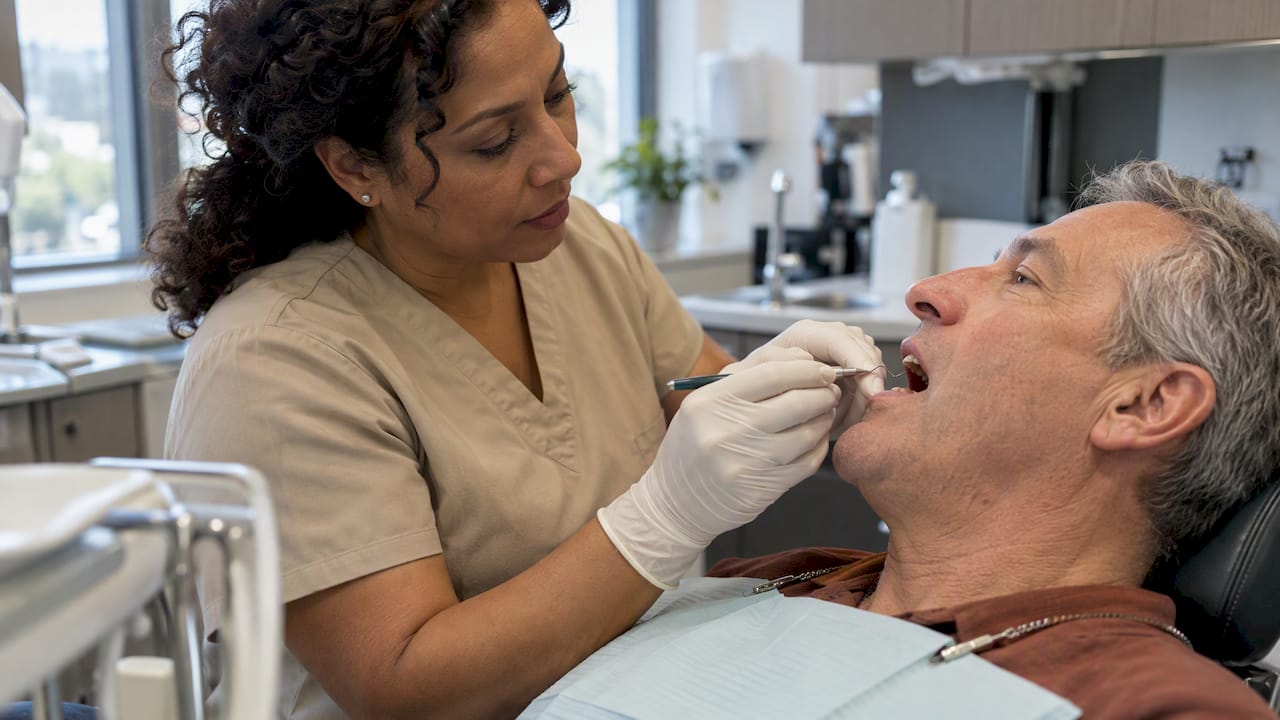
From those findings, the dentist builds a plan. In Canada, the National Dental Examining Board lists competencies that include establishing diagnoses, developing comprehensive prioritized and sequenced treatment plans, and discussing risks, benefits, alternatives, prognosis and fees, then obtaining informed consent. That gives you a practical checklist for your own consultation.
Questions worth asking at the consultation
- What exactly did you find in my teeth, gums and bite, and what is the priority order?
- What are my options, including a smaller or staged plan?
- How long will each phase take, and how many visits should I expect?
- What will it cost in total, and which parts are phased over time?
- What happens if my gums or bite need work first?
- How will I protect the result afterward, for example with a night guard?
A plan you cannot get in writing, or one that skips the exam and moves straight to a quote, deserves a second look.
Treatments that may be combined, and in what order
Because every mouth differs, there is no single recipe. Depending on what your exam shows, a plan may combine:
- Gum therapy and deep cleaning to bring inflammation under control. Our guide to scaling and root planing explains what that involves.
- Fillings, root canal treatment and crowns to rebuild damaged teeth. See our overview of restorative dentistry.
- Bridges or implants to replace missing teeth. We compare the two in dental bridge vs implant.
- Veneers or bonding where front teeth need an aesthetic upgrade alongside the functional work.
- Clear aligners or other orthodontic steps where tooth position needs correcting first.
- Bite protection, such as a night guard, to shield the new work from grinding.
The usual logic is health first, structure second, finish last. Disease is controlled and any urgent problems are handled. Then the foundation is rebuilt. Aesthetic refinements come at the end. Many plans also include a trial or evaluation stage, where a provisional version of the new teeth lets you test the look and feel before the final restorations are made. An international consensus from 2025 noted that the evidence on whether this phase is strictly necessary is inconclusive, but that it is highly valuable for managing patient expectations and for supporting less experienced clinicians. In plain terms: ask whether a preview stage is part of your plan.
Treatment is often spread over several visits and sometimes several months, because healing and adjustments take time. Your dentist should give you a realistic timeline for your own case.
The bite, the jaw joints and the muscles
What separates rehabilitation from a set of individual repairs is the focus on how everything works together. A widely cited review states that the aim is to re-establish functional and biological harmony among the teeth, periodontal structures, chewing muscles and the temporomandibular joint (TMJ). The 2025 review makes a similar point: success depends on coordinating the tooth restorations with gum health, the bite, the jaw joints and the chewing muscles.
That is why a clinician will look at how your teeth meet, not only at how each tooth looks. A crown that is slightly too high, or a bite that forces your jaw into a strained position, can lead to soreness or damage the new work.
For some patients, overactive jaw muscles are part of the picture. Clenching can wear teeth and tire the muscles that close the jaw, and some people explore options such as masseter Botox for TMJ symptoms to relax those muscles. If that interests you, ask your dentist whether it fits your situation. At our clinic, we offer TMJ and masseter Botox as part of a broader plan for jaw tension.
What to expect during treatment and recovery
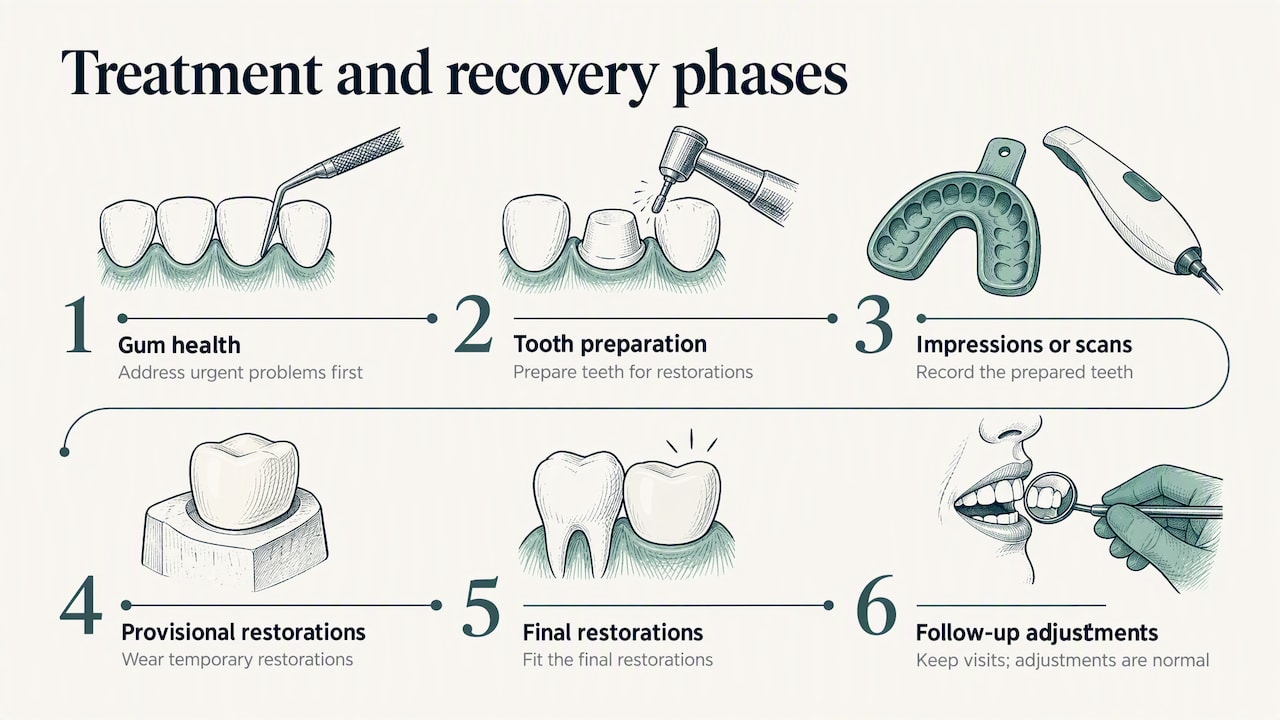
Expect treatment to feel like a series of manageable phases rather than one long appointment. Early visits focus on gum health and urgent problems. Later visits involve preparing teeth, taking impressions or scans, wearing provisional restorations and then fitting the final ones. Your mouth may feel sore or sensitive after procedures, and the bite may feel unfamiliar for a short time. Adjustments are a normal part of the process, so keep your follow-up visits.
The way to reduce risk is to choose a plan built on good process. Regulatory documents show what can go wrong when process is skipped. A notice of hearing from Ontario’s dental regulator alleges deficiencies in implant cases, including inadequate pre-implant examination and treatment planning or sequencing, failure to plan stabilization of active gum disease, inadequate informed consent about risks, alternatives, cost and duration, and treatment beyond competence without referral. These are allegations in one case, not a finding about the profession. But they point to what you should expect from any clinic: a full exam, a sequenced plan, gum disease handled first, a clear conversation about cost and duration, and a referral when a case needs a specialist.
If you get a crown that loosens along the way, do not wait. Our page on what to do when a dental crown falls out covers the immediate steps.
Protecting the result for the long term
Rehabilitation is an investment, and maintenance is what protects it. For a sense of scale, the Canadian Dental Association says fixed bridges are typically expected to last about 10 years, or longer with meticulous daily care and professional maintenance. Other restorations follow the same principle: lifespan depends heavily on what you do at home and how often a professional checks the work.
A practical routine looks like this:
- Brush twice a day and clean between teeth daily. Margins where a crown meets a tooth are where new decay tends to start.
- Wear your night guard if you were given one. It protects new restorations from grinding forces.
- Book regular hygiene visits. Professional cleanings keep gums stable, and your dental team can check restorations and the bite.
- Stay on a proactive schedule. Catching small changes early is cheaper and gentler than repairing big ones, which is the idea behind our proactive dentistry approach.
- Avoid using your teeth as tools. Opening packaging or chewing ice puts the same stress on new work as on natural teeth.
Our perspective
When someone comes to us with worn, broken or missing teeth in several places, the most common thing we hear is that they have been patching problems for years. Each repair made sense on its own. Together, they never added up to a mouth that works comfortably.
We believe the answer is to step back and look at the cause. Why are the teeth wearing? Are the gums stable? How does the bite fit together? Is the jaw under strain? Treating the symptom alone tends to repeat the cycle, so our approach is evidence-based, whole-body and focused on root causes.
We also believe comfort is part of good dentistry. Many people put off rehabilitation because of fear or past experiences. We aim to create a judgment-free environment, to explain each step in plain language, and to offer sedation options when they would help you get the care you need.
A plan should be personal. Some patients need a staged, partial approach and some need a more comprehensive one, and the decision should come from a thorough exam and an honest conversation, not from a template.
Deane
Considering full-mouth rehabilitation in Calgary
If you recognize the signs above, the first step is a conversation, not a commitment. At Vigée Dental in Calgary, we start with a thorough exam and walk you through what we find, your options and a phased plan. Our services span restorative and cosmetic work, sedation dentistry and ongoing preventive care, so your plan can be coordinated in one place. Pricing depends on your individual plan, so we do not publish a fixed figure.

To get started, read about full-mouth rehabilitation at Vigée Dental or book a new patient exam.
FAQ
What does full-mouth rehabilitation mean?
It means a comprehensive, individualized plan to restore the teeth, gums, bite and jaw function across the whole mouth. Its goals are oral health, efficient chewing, comfort and aesthetics. It may include several types of treatment delivered in a planned order.
Does everyone with damaged teeth need it?
No. If only one or two teeth are affected, a targeted repair is usually enough. A whole-mouth plan is considered when problems are widespread or connected, such as heavy wear, many failing restorations, missing teeth, or bite and jaw problems. An exam is the only way to know which applies to you.
How long does it take?
It depends on how much work your mouth needs and how long gums and tissues take to heal between phases. Most plans are carried out over several visits, and some stretch across months. Ask for a timeline for each phase at your consultation.
How do I make my results last?
Daily brushing and cleaning between teeth, regular professional hygiene visits and a night guard if you grind your teeth are the basics. The Canadian Dental Association notes that restorations such as bridges last longer with meticulous home care and professional maintenance.
Sources
- Full Mouth Rehabilitation: A Review Article
- Effect of Occlusal Schemes on Long-Term Prosthetic Success in Full-Mouth Rehabilitation
- Occlusal Concepts in Full Mouth Rehabilitation: An Overview
- The Dental Exam, Canadian Dental Association
- Competencies, The National Dental Examining Board of Canada
- Examining Gum Health, University of Toronto Faculty of Dentistry
- Rehabilitation Strategies and Occlusal Vertical Dimension Considerations
- Notice of Hearing, Royal College of Dental Surgeons of Ontario
- Bridges, Canadian Dental Association
- Does Masseter Botox Help TMJ? What It Can and Can’t Do