

Periodontal maintenance is the long-term gum care you receive after active treatment for gum disease (periodontitis). It is not a routine cleaning. The American Academy of Periodontology says it is not synonymous with prophylaxis once active therapy is finished. A visit combines a careful gum examination, measurement of pocket depths, cleaning above and below the gumline, and coaching on your home care. Most people start at about every three months, then the interval is adjusted to your risk.
If you have been told you need a “periodontal cleaning” or “gum disease cleaning”, this guide explains what that means, what you will feel and see in the chair, how often to go, and what the evidence says about why it is worth keeping up.
TL;DR
- Periodontal maintenance is ongoing care after gum disease treatment. It checks for recurrence and removes bacterial buildup you cannot reach at home.
- It differs from a routine cleaning because it includes a full gum re-evaluation, risk assessment and cleaning below the gumline.
- Guidelines suggest visits every 3 to 12 months, set by your risk. Many patients begin at 3 months.
- Skipping visits is linked to more tooth loss. Insurance plans often cover periodontal services at a percentage, so check your plan.
Table of Contents
- What periodontal maintenance actually is
- Why it is recommended after gum disease treatment
- What happens at a periodontal maintenance visit
- Periodontal maintenance vs. routine cleaning vs. deep cleaning
- How often you need it
- Is periodontal maintenance worth it?
- Can pockets improve?
- Perspective
- Paying for periodontal maintenance in Canada
- Making your visits count
- Gum care in Calgary at Vigée Dental
- FAQ
- Sources
What periodontal maintenance actually is
Gum disease is a chronic condition. Active treatment, which often means scaling and root planing (a deep cleaning below the gumline), brings the infection under control. Maintenance is what keeps it under control afterward.
The 2017 World Workshop classification states that a person with periodontitis remains a periodontitis patient for life and needs lifelong supportive care to prevent recurrence. That does not mean your gums stay inflamed. It means the tendency to relapse stays, so the monitoring stays too.
The goals, as described in an academic practice information sheet, are practical:
- Monitor changes in your teeth and mouth.
- Reinforce effective plaque control at home.
- Control inflammation and prevent recession.
- Keep your attachment stable and preserve the bone that holds your teeth.
The overall aim is to keep your own teeth for life.
Why it is recommended after gum disease treatment
The bacteria that cause periodontitis re-form in the pockets around your teeth. Even with excellent brushing and flossing, the deeper areas are hard to reach. Left alone, they rebuild into a mature biofilm and eventually hardened deposits (see our guide to plaque versus tartar).
The American Academy of Periodontology’s parameter on maintenance notes that failing to follow a maintenance program may allow the disease to recur or progress. Patients should be informed of the disease process, the options, the expected results and their own part in treatment.
What the long-term studies show
Research gives a reasonably clear picture of what happens when people keep their appointments:
- A 30-year follow-up of 154 patients treated for periodontitis who kept up supportive care at 3-to-6-month intervals found only 5.1% of teeth were lost overall. Stage III or IV disease was linked to more tooth loss than Stage I or II.
- In a study of 92 treated patients followed for a mean of 6.7 years, those who attended erratically had 5.6 times the risk of tooth loss compared with those who attended regularly.
- A 2016 cohort study of localized aggressive periodontitis found therapy improved probing depth and attachment level for up to 4 years, and that missed appointments and not following medication instructions hurt the response.
The pattern is consistent: treatment works best when it is followed by regular upkeep.
What happens at a periodontal maintenance visit
Visits vary by office, but the components come from the same professional definitions. According to the AAP definition, under dentist supervision the procedures typically include:
- Updating your medical and dental history.
- Reviewing radiographs (x-rays).
- Examining soft tissues and teeth.
- Evaluating your periodontal condition.
- Removing bacterial deposits from the crevicular and pocket areas.
- Scaling and root planing where indicated.
- Polishing.
- Reviewing how well your plaque control is working.
The gum examination is the key step
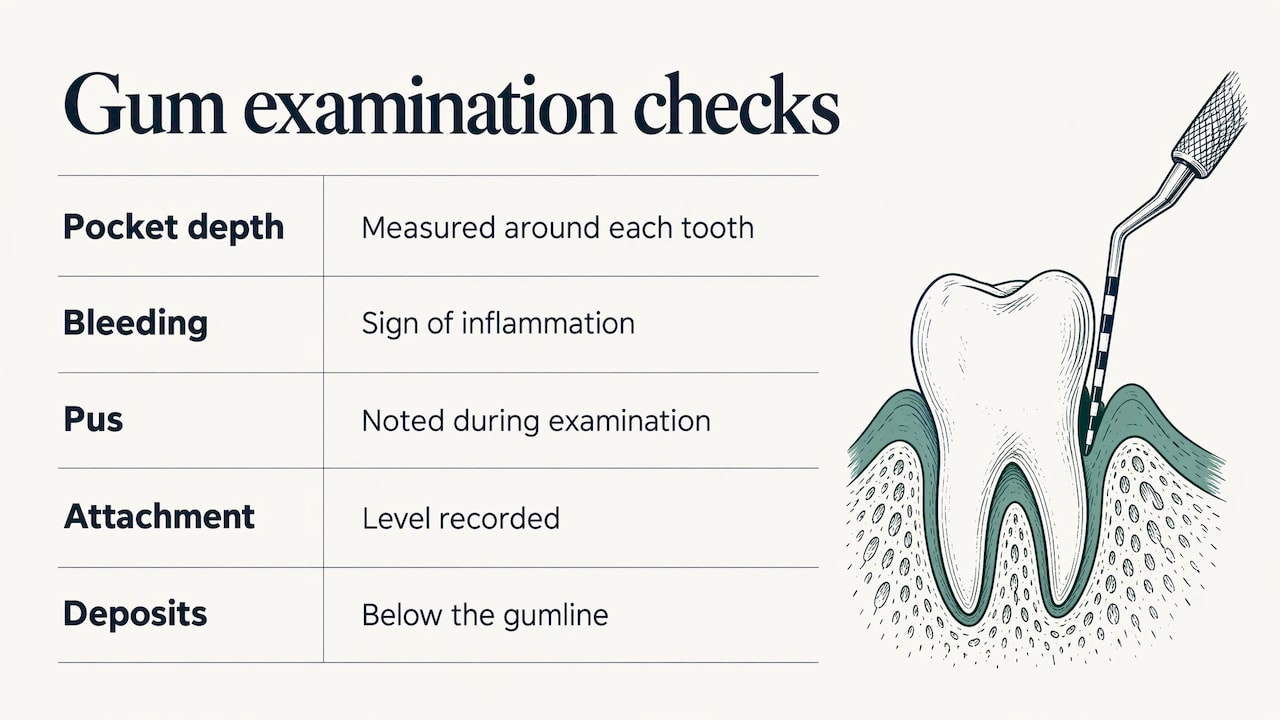
The periodontal examination is described as the most important part of maintenance, because it shows whether inflammation is present and whether disease has returned. Your hygienist uses a thin probe to measure the depth of the pockets around each tooth and notes bleeding, pus, attachment level and any deposits below the gumline.
Bleeding when probed is a sign of inflammation. The 2017 classification recommends measuring bleeding on probing at every scheduled visit to judge gum health and prevent progression. If your gums bleed when you brush or floss at home, read our page on bleeding gums and mention it at your visit.
Cleaning below the gumline
Subgingival plaque needs to be removed as part of maintenance even when no active disease shows up, according to the same practice sheet. Sites that look unstable may be treated again with scaling and root planing. Our overview of scaling and root planing covers the steps and recovery.
Coaching on home care
At each visit you should be told about your condition and the factors that make it worse, such as poor oral hygiene, smoking and diet. Reinforcing motivation and technique is considered essential.
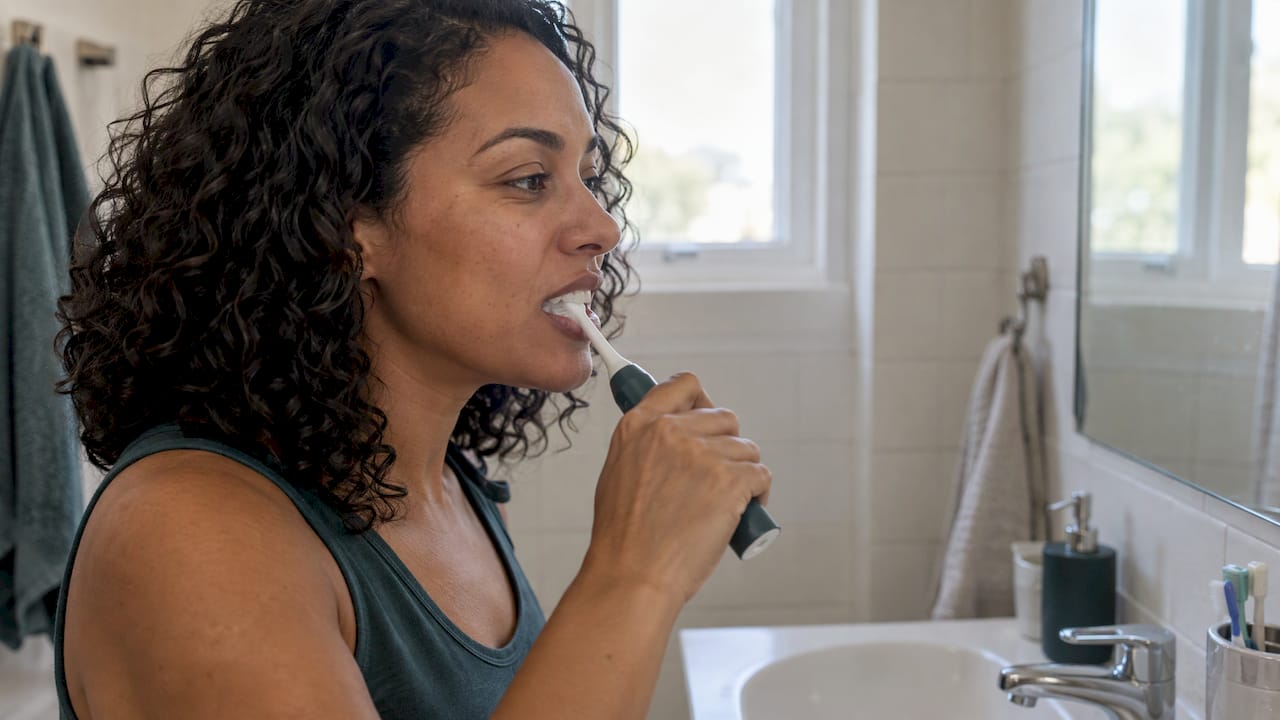
Tools matter too. A 2024 randomized trial of 328 people with Stage I/II periodontitis found that scaling and root planing plus a daily powered toothbrush reduced bleeding, plaque and pocket depth more than a manual brush at 24 weeks, and the powered group sustained its pocket-depth gains. Ask your hygienist what brush, interdental tool and technique suit your mouth.
Periodontal maintenance vs. routine cleaning vs. deep cleaning
These three terms get mixed up. This table separates them.
| Routine cleaning (prophylaxis) | Deep cleaning (scaling and root planing) | Periodontal maintenance | |
|---|---|---|---|
| Who it is for | Healthy gums | Active gum disease | Patients who have completed gum disease treatment |
| Purpose | Prevent disease | Treat existing infection below the gumline | Keep treated disease stable and catch recurrence early |
| Pocket measurements | Screening | Detailed baseline | Re-measured and compared every visit |
| Below the gumline | Not the focus | Main focus | Cleaned as needed, with re-treatment of problem sites |
| Typical timing | Often every 6 months | Once, sometimes by area of the mouth | Often every 3 months at first, then adjusted |
The 2018 Cochrane review says supportive therapy should include a standard recall exam, periodontal re-evaluation and risk assessment, removal of plaque and calculus above and below the gumline, and re-treatment of sites with recurring or persistent disease. The thorough evaluation and risk assessment are what set it apart from routine care.
So a periodontal cleaning is not simply a longer cleaning. It is a monitoring visit with treatment built in. For the routine side of care, see our page on teeth cleanings and dental hygiene.
How often you need it
The short answer: more often than a standard cleaning, at first.
- The European Federation of Periodontology guideline says supportive care visits should be set at intervals of 3 to a maximum of 12 months, tailored to your risk profile and periodontal condition after active therapy. The UK guidance built on it gives the same 3 to 12 month range.
- An academic practice sheet advises maintenance every three months in the first year after active therapy. For stable patients with excellent hygiene, no inflammation and only shallow pockets left, the interval may be extended.
- In Canada, the six-month recall is the most common default, with three months commonly used for periodontal maintenance, and the Canadian Dental Association favours individual risk assessment over one fixed schedule.
What moves your interval
Your dentist or hygienist will weigh how deep your remaining pockets are, how much your gums bleed, how much bone you have lost, how well you clean at home, and habits such as smoking. The 30-year study also flagged age, molar teeth, pocket depth, bone loss, root canal treatment and crowns as factors linked to tooth loss. A tooth with several of these may deserve closer watching.
Is periodontal maintenance worth it?
The evidence is honest about its limits. A 2018 Cochrane review found insufficient evidence to say which supportive protocol or add-on is best, and no trials compared supportive therapy with monitoring alone. That is mostly because it would be hard to ethically withhold care from people with a known disease. The long-term cohort data above is what most clinicians rely on, and it points the same way: regular attendance goes with far fewer lost teeth.
There is also a practical reason. Replacing a tooth is far more involved than keeping one, and gum disease that returns often needs more treatment than the upkeep would have.
Can pockets improve?
People often ask whether a 5 mm pocket can be reversed. Pockets can shrink after treatment: the 2016 cohort reported average reductions of about 2.18 mm in probing depth and 2.80 mm in attachment level. Bone and attachment already lost do not simply grow back on their own, so the realistic goal is to stabilize, keep pockets shallow and keep them clean. Your own measurements, compared visit to visit, tell you where you stand. Gum recession is a related concern, covered in our guide to gum recession.
Perspective
At Vigée Dental we think of gum health as part of whole-body wellness, not a cosmetic afterthought. Our approach is evidence-based and aims at the root cause of a problem, not only the symptom. With gum disease, that means looking at what keeps the inflammation going: home care habits, plaque and tartar, and your overall health.
We also know that many patients put off gum care because they feel judged or anxious. We work to make visits personalized, comfortable and judgment-free, and we offer sedation options for patients who need them. Honest conversation about where your gums are today is the starting point.
We believe the most valuable thing in maintenance is consistency. A short, regular visit that catches a change early is easier on you than a long treatment later. Our proactive care and deep cleaning for gum health services are built around that idea.
Deane
Paying for periodontal maintenance in Canada
Fees depend on the office, the time needed and your plan, so ask for an estimate before your visit. Our page on dental cleaning costs in Calgary is a good starting point for general hygiene fees.
Insurance varies a lot. Two examples of how plans handle it:
- Canada Life’s Select policy (effective January 1, 2026) covers periodontal services listed in the periodontic section of the Canadian Dental Association’s coding system. Routine dental expenses are reimbursed at 70% of the lesser of the billed cost and the fee guide, up to $350 per calendar year.
- Pacific Blue Cross’s Essential Dental Plan lists periodontal cleaning as an eligible expense, at 70% basic for the first 12 months and 80% after, with annual maximums of $600, $900 and $1,200 per person across the first three stages.
Benefits, limits and waiting periods differ by employer and plan. Read your own booklet or call your insurer, and ask how it treats the visit code for periodontal maintenance versus a regular cleaning, since the two are often billed differently.
Making your visits count
- Tell the hygienist about bleeding, sensitivity, medication changes and any new health diagnosis.
- Ask for your pocket measurements and what has changed since last time.
- Clean between your teeth daily. Ask which tool fits your spacing.
- If you smoke, ask for help to cut back. It is named among the aggravating factors to discuss at each visit.
- Book your next appointment before you leave, so the interval holds.
For more reading on prevention, our preventive and proactive care page and dental health blog cover the basics.
Gum care in Calgary at Vigée Dental
If you live in Calgary and want a team that treats gum health as part of your whole-body wellness, we can help. Our preventive services include routine checkups, dental hygiene, deep cleaning for gum health and proactive dentistry. Dental anxiety is common, and our sedation options and judgment-free approach are there for it. To get started, book a new patient exam through Vigée Dental.

We will review your history and your gums, explain what we find in plain language, and talk through a plan that fits you.
FAQ
Is periodontal maintenance the same as a deep cleaning?
No. A deep cleaning (scaling and root planing) treats active gum disease. Periodontal maintenance comes afterward and combines re-measuring your pockets, a risk assessment, cleaning above and below the gumline, and re-treating any sites that have relapsed. Some visits include scaling where it is indicated.
How often should I have a periodontal cleaning?
Guidelines give a range of 3 to 12 months, set by your risk. Many patients start at every three months during the first year, then your dentist may lengthen the interval if your gums are stable and your home care is excellent.
What is included in periodontal maintenance?
A typical visit includes a history update, x-ray review, an exam of your teeth and soft tissues, gum probing, removal of bacterial deposits from pocket areas, polishing and a review of your home care. The AAP definition lists these procedures.
What happens if I skip periodontal maintenance?
Gum disease can recur or progress. In one study, patients who attended erratically had 5.6 times the risk of tooth loss compared with regular attenders. If you have missed visits, book one now rather than waiting for symptoms.
Does insurance cover periodontal maintenance in Canada?
Many plans cover periodontal services at a percentage, up to a yearly maximum. For example, Canada Life’s Select policy reimburses routine dental expenses at 70% up to $350 a year. Check your own plan for the exact terms.
Sources
- Periodontal maintenance, AAP glossary
- Maintenance Phase of Periodontal Care, University of Adelaide
- Parameter on periodontal maintenance, American Academy of Periodontology
- The New Global Classification System for Periodontal and Peri-implant Diseases
- Supportive periodontal therapy for maintaining the dentition, Cochrane review 2018
- Longevity of teeth in patients susceptible to periodontitis, 30-year follow-up
- Retrospective study of tooth loss in 92 treated periodontal patients
- Long-term clinical response to treatment and maintenance of localized aggressive periodontitis
- Scaling and root planing plus home oral hygiene, 2024 randomized trial
- Supportive periodontal care, EFP guideline
- Supportive periodontal care, Scottish Dental Clinical Effectiveness Programme
- Recall intervals in Canadian dental practices
- Canada Life Select policy booklet
- Pacific Blue Cross dental-only plans