
Some sensitivity after a filling is common and usually fades within days to a few weeks. Pain that lingers, wakes you at night, throbs on its own or hurts every time you bite is different: it means the filling or the tooth needs a check, and a quick visit often fixes it. If you are in Calgary and unsure which side of the line you are on, our team at Vigée Dental can assess the tooth and adjust or treat it.
TL;DR
- Short, sharp zings to cold, sweet or air are the typical pattern after a filling, and they usually settle within a week to a month.
- Pain when you bite usually means the filling sits too high. It is a simple adjustment, so do not wait it out.
- Pain that lingers more than 30 seconds after hot or cold, throbs by itself or keeps you up at night needs a prompt dental assessment.
- The same rules apply to a tooth that hurts after a crown, and a crown that starts to hurt months or years later can mean decay underneath.
- Sensitive-tooth toothpaste is the gentlest first step at home while you monitor the tooth.
Table of Contents
- Why a tooth can hurt after a filling
- What is normal, and how long it lasts
- Pain when you bite
- Hot, cold and sweet sensitivity: what helps at home
- Signs the nerve needs attention
- When the tooth was cracked, not just decayed
- Pain after a crown
- What a dentist does at the visit
- Our perspective
- Getting it checked in Calgary
- FAQ
- Sources
Why a tooth can hurt after a filling
A filling removes decay and replaces it with material, but the tooth was already irritated by the cavity and then by the treatment itself. Decay hurts once it reaches the dentin, the softer layer under the enamel. Dentin is full of microscopic channels, and when fluid inside them moves, it triggers the nerve. The Merck Manual’s Canadian professional edition explains that as long as discomfort does not persist after the stimulus is removed, the nerve is likely healthy and the tooth is simply sensitive in a reversible way.
A 2026 review of sensitivity after composite (tooth-coloured) fillings describes the same mechanism: quick fluid movement in those channels produces a short, sharp pain to cold, air, sweets or pressure.
What happens during the procedure
A 2020 overview in BMC Oral Health lists several things that can irritate a tooth while it is being prepared: heat from drilling without enough cooling, heavy cutting pressure, vibration and drying out of the dentin. For tooth-coloured fillings it adds leakage at the edges, imperfect bonding and strain on the cusps. For silver (amalgam) fillings it names leakage, hairline cracks and contacts that hit too early when you close your teeth.
Who is more likely to feel it
The 2026 review notes that sensitivity is more likely when:
- the cavity was deep or large and close to the nerve
- the tooth was already sensitive before treatment
- the tooth has cracks or craze lines
- you clench or grind, which puts heavy load on the tooth
If you already notice zings from cold drinks before any treatment, our guide to why teeth react to cold explains the common causes.
What is normal, and how long it lasts
Normal looks like this: a brief, sharp response to cold, sweets, cold air or chewing pressure that stops soon after the trigger is gone, and that gets a bit better each day.
According to the 2026 review, sensitivity is most often reported in the first 24 to 72 hours and typically declines over the first week. Many cases improve by one week and resolve by one month, especially when the bite and the edges of the filling are right. The American Association of Endodontists gives a similar window for sensitivity to hot or cold after dental work: wait two to four weeks, and if it persists or worsens, have a dentist check it.
| What you feel | Usually means | What to do |
|---|---|---|
| Quick zing to cold or sweet, gone in seconds, improving daily | Reversible nerve irritation | Monitor, use sensitive-tooth toothpaste |
| Soreness only when you bite or chew | Filling sits high | Book a bite adjustment this week |
| Pain that lingers 30 seconds or more after hot or cold | Nerve may be badly inflamed | Book a prompt assessment |
| Throbbing on its own, or worse at night | Nerve inflammation that may not reverse | Call a dentist promptly |
| Swelling, a pimple on the gum, fever | Possible infection | Same-day dental care or emergency care |
Pain when you bite
If the filling is slightly too high, that tooth hits first when you close your mouth. The tooth and its ligament take extra load, and the result is a dull ache or sharp pain on chewing, sometimes with jaw tiredness. The 2026 review recommends adjusting the bite when pain is biting-related. It is usually a few minutes of careful polishing, often needs no freezing, and relief tends to follow quickly.
Do not wait for a high filling to wear down on its own. Chronic overloading can keep the tooth sore, and if you clench or grind, the jaw muscles can ache too. Our overview of TMJ symptoms covers jaw pain, clicking and headaches that sometimes get mistaken for a tooth problem.
Hot, cold and sweet sensitivity: what helps at home
While you monitor the tooth:
- Switch to desensitizing toothpaste. A 2022 review in the Open Dentistry Journal describes it as the most effective and least invasive remedy for dentin sensitivity. Products with potassium nitrate or stannous fluoride calm nerve excitability, and using them twice a day for up to two weeks gives effective results.
- Brush gently with a soft brush and lukewarm water.
- Ease off extremes. Very cold drinks, ice and hot soup tend to set the tooth off while it settles.
- Chew on the other side for a few days if pressure bothers you.
Some people also look at nano-hydroxyapatite products, and there is a guide on nano hydroxyapatite for sensitive teeth that explains how they are used for everyday sensitivity.
If you take pain relievers, follow the label and ask your pharmacist or dentist if you have other medications or health conditions.
Signs the nerve needs attention
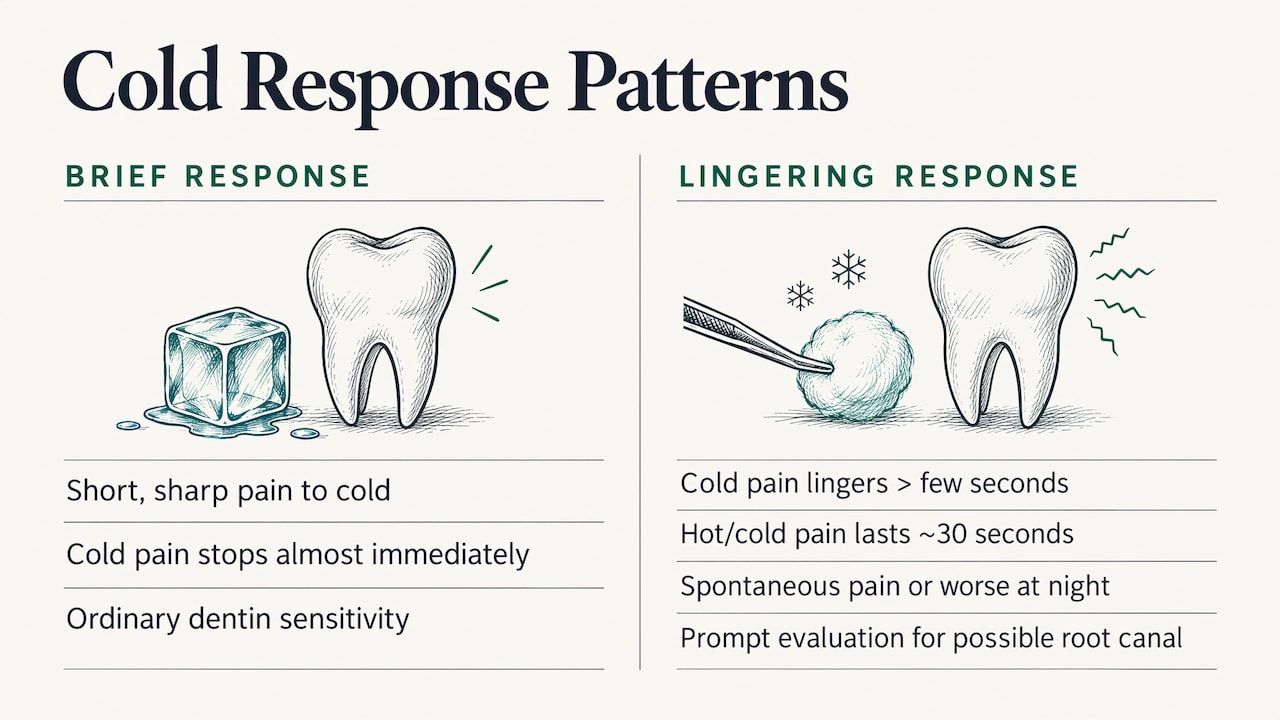
The 2026 review separates two patterns. Short, sharp pain to cold that resolves quickly points to ordinary dentin sensitivity. Spontaneous pain, a cold response that lingers, or pain that escalates at night raises concern that the nerve is inflamed beyond recovery.
The Merck Manual describes how dentists test this: a brief touch of ice or a chilled cotton pellet. In a healthy tooth the pain stops almost immediately. If it lingers more than a few seconds, the nerve is damaged. The AAE puts the practical line at about 30 seconds after hot or cold and advises a prompt evaluation for possible root canal treatment.
A root canal sounds alarming, but it removes the inflamed nerve and ends the pain. If you want to know what to expect, read signs you may need a root canal and how long a root canal takes.
Swelling in the gum or face, a bad taste, fever or a small bump on the gum next to the tooth need care the same day. Facial swelling with trouble swallowing or breathing is an emergency: go to an emergency department.
When the tooth was cracked, not just decayed
Sometimes pain continues because the tooth has a crack that was hidden by the decay. Biting pain that is sharp and comes and goes, especially when you release the bite, is a typical clue. Cracks need to be assessed in person, and the earlier the better. Our page on a chipped, cracked or broken tooth explains the options.
Pain after a crown
A crown is a cap that covers the whole tooth, so the tooth is reshaped and trimmed first. The causes overlap with fillings:
- Sensitivity from the preparation. Trimming the tooth irritates the nerve. It usually eases over days to a few weeks, and the same two to four week guidance applies.
- A high crown. Pain on biting means the bite needs a small adjustment.
- Gum soreness. The gum around the edge can be tender for a few days.
- Nerve damage. If the tooth was already deeply decayed or traumatized, the nerve can fail after the crown is placed, with lingering or spontaneous pain.
If you chew and feel the crown move, or it has come off, see what to do when a dental crown falls out.
Decay under a crown
A crown covers the tooth but does not make it immune to decay. If the seal at the margin loosens, bacteria can get in beneath the crown and decay the tooth where you cannot see it. Typical signs are new sensitivity to cold or sweets months or years after the crown, a bad taste or smell around it, a gap or rough edge at the gum line, or a dull ache that appears from nowhere.
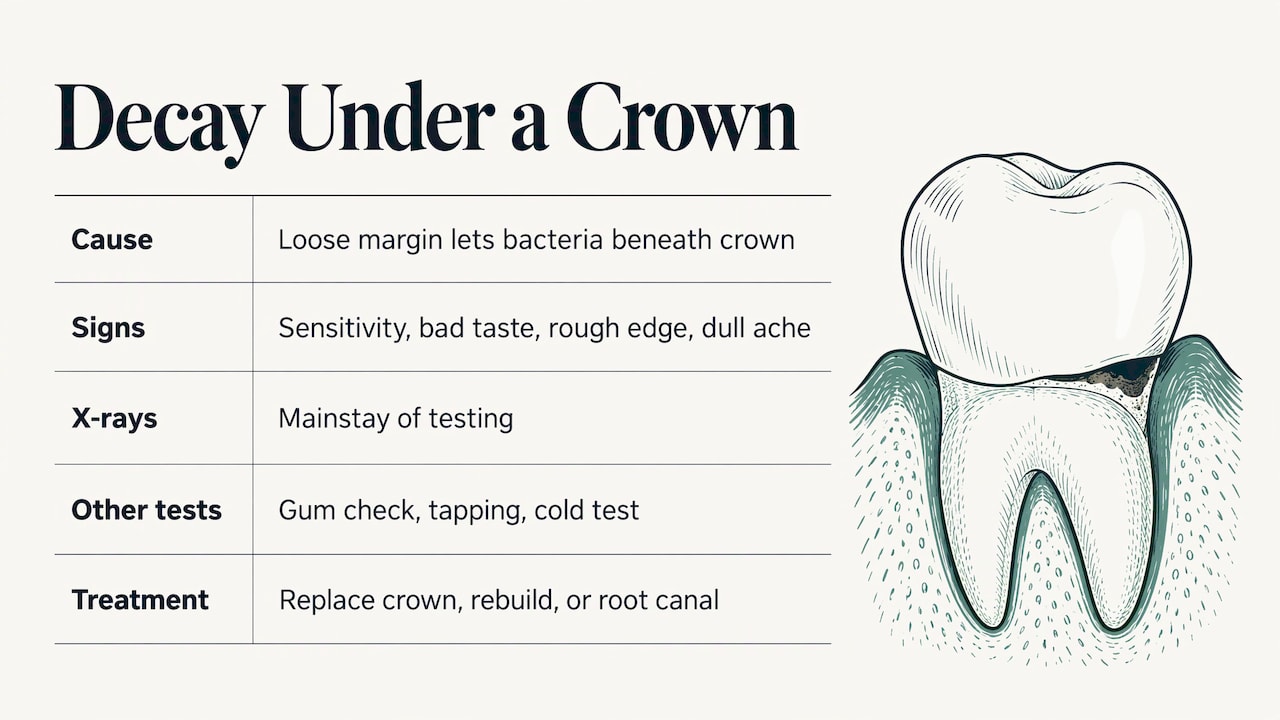
A dentist checks the tooth with X-rays, which the Merck Manual calls the mainstay of testing, along with inspecting the gums, tapping the tooth for tenderness and doing the cold test. Depending on what is found, treatment may mean replacing the crown after removing the decay, building the tooth up again, or root canal treatment if the nerve is involved. Decay caught early leaves more of the tooth to save, so a new twinge under an old crown is worth a booking.
What a dentist does at the visit
- Listens to the pattern: what triggers it, how long it lasts, whether it started right after treatment.
- Checks the bite with marking paper to find a high spot.
- Tests the nerve with a cold test and taps on the tooth.
- Takes an X-ray to look at the depth of the filling, decay near the nerve, a crack or a problem under a crown.
- Chooses the fix: adjusting the bite, sealing sensitive areas, replacing a leaking filling, or treating the nerve.
Our perspective
Most patients who call about pain after a filling are worried they were treated badly. Usually they were not: the tooth is simply irritated and needs a few weeks, a bite adjustment, or a closer look. What matters is not putting up with it in silence.
We approach dentistry by looking for the root cause of a problem rather than treating only the symptom. A sore tooth is a good example. A bite that is slightly off, a crack, or a leaking edge each need a different answer, and the right one comes from examining the tooth, not guessing.
We also know many people avoid going back because they feel embarrassed or anxious about returning to the chair. Our clinic is built to be judgment-free, and we offer sedation options for patients who need them.
Deane
Getting it checked in Calgary
Vigée Dental in Calgary offers restorative dentistry, root canal therapy and emergency dentistry under Dr. Nicole Robins. If you are anxious about going back, we also offer sedation dentistry. If your fillings or crowns are part of a bigger plan, we also do full-mouth rehabilitation.

To book an assessment for a sore tooth or a new patient exam, visit vigeedental.ca.
FAQ
How long should a tooth hurt after a filling?
Most sensitivity peaks in the first few days and fades over the first week, with many cases resolving within a month. If it is not clearly improving after two to four weeks, or it is getting worse, have it checked.
Why does my tooth hurt when I bite after a filling?
The most common reason is that the filling sits slightly too high, so that tooth takes extra force. A dentist can fix it with a quick adjustment. A crack in the tooth can also cause biting pain, which is why persistent pain should be examined.
Is it normal for a filling to be sensitive to cold months later?
Not usually. Sensitivity should settle within about a month. New or lasting cold sensitivity later can mean a leaking edge, new decay at the filling, a crack or an inflamed nerve, so book an exam with an X-ray.
Can a tooth decay under a crown?
Yes. If the seal at the edge of the crown weakens, bacteria can reach the tooth underneath. Warning signs include new sensitivity, a bad taste or a dull ache. A dentist can confirm it on an X-ray.
What should I do if the pain wakes me at night?
Pain that throbs on its own or builds at night suggests the nerve may be inflamed beyond recovery. Call a dentist promptly. Do not wait for it to pass, and seek emergency care if you have facial swelling or fever.
Sources
- Post-operative sensitivity after composite restorations, IJMEDPH 2026
- Pathogenesis, diagnosis and management of dentin hypersensitivity, BMC Oral Health 2020
- Toothache and Infection, Merck Manual Professional Edition (Canada)
- Advances in the Management of Dentin Hypersensitivity, Open Dentistry Journal 2022
- Tooth Pain, American Association of Endodontists