
No-prep veneers are ultra-thin shells bonded to your teeth with little or no drilling, and they work best when your teeth are healthy, well aligned and you want a refined change rather than a total reshape. Whether you are a good fit depends on your enamel, your bite and what you want to change, so the most useful first step is an exam with a dentist who offers both no-prep and traditional options. At Vigée Dental in Calgary, no-prep veneers are part of our cosmetic dentistry, and we can preview the result before you commit.
TL;DR
- No-prep veneers are thinner than conventional ones and keep most of your natural enamel, but they suit carefully selected cases only.
- They are not the right tool for deep intrinsic staining, crooked teeth or large breaks; traditional veneers or other treatment cover those.
- Reviews report high survival for well-selected no-prep cases, and success depends heavily on case selection and the dentist’s technique.
- Veneers are usually cosmetic, so plan for out-of-pocket costs and ask for a written estimate.
- Book a consultation to find out which type fits your teeth.
Table of Contents
- What no-prep veneers are
- No-prep, minimal-prep and traditional: how to tell them apart
- Who is a good candidate
- How the process works
- How long they last and how to look after them
- Can no-prep veneers be removed?
- What no-prep veneers cost in Calgary
- Our perspective
- Start with a consultation at Vigée Dental
- FAQ
- Sources
What no-prep veneers are
A veneer is a very thin shell of porcelain or composite resin attached to the front of a tooth. The Canadian Dental Association says veneers are used for stained, chipped or misshapen teeth, to cover gaps and to correct slightly crooked teeth.
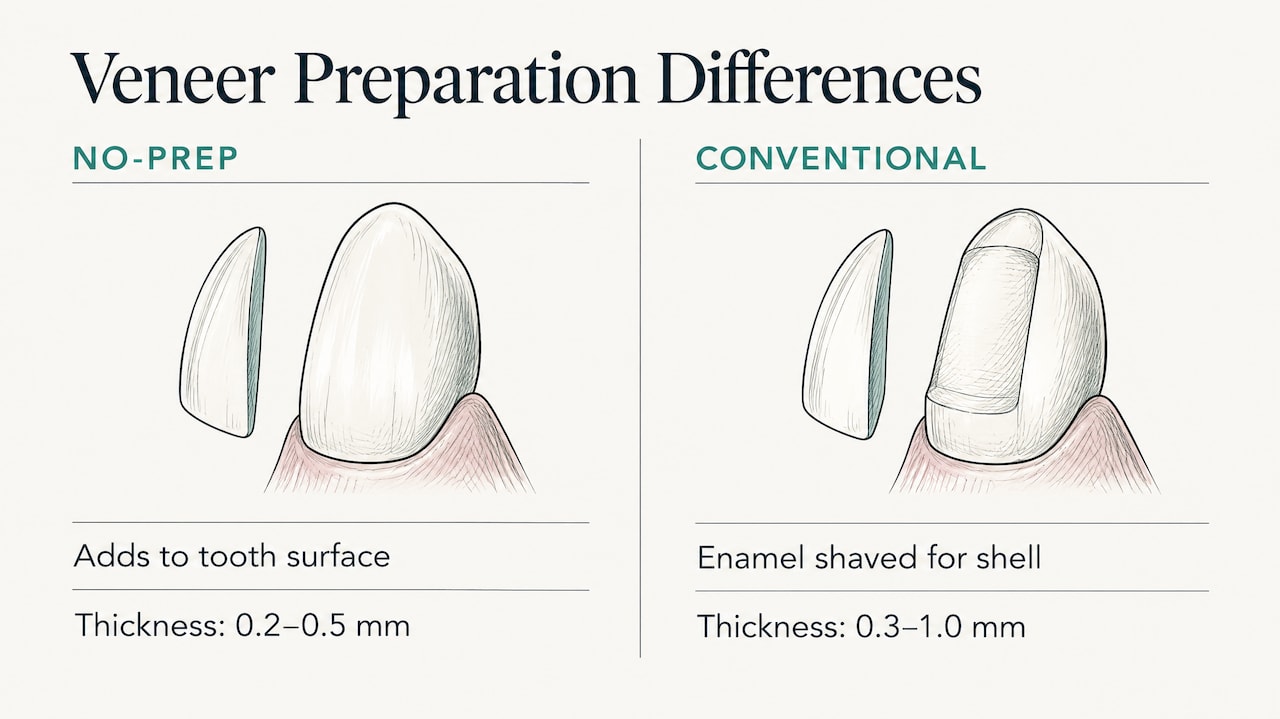
The difference is how much tooth is removed first. Traditional veneers need the dentist to shave enamel so the shell has room to sit. No-prep (or minimal-prep) veneers are designed to add to the tooth surface instead of replacing it. That is why they are often described as “minimal drilling.”
They are also thinner. A 2023 systematic review reports minimally invasive veneers at 0.2 to 0.5 mm thick, against 0.3 to 1.0 mm for conventional ones.
Why less preparation matters to patients
Enamel is the hardest, best bonding surface on your tooth, and once it is removed it does not grow back. A 2026 review in Bioinformation describes the no-prep approach as additive: it keeps natural contours and reduces the need for anesthetic or temporary restorations. For anyone nervous about needles and drills, that is a real comfort advantage.
No-prep, minimal-prep and traditional: how to tell them apart
| No-prep / minimal-prep | Traditional | |
|---|---|---|
| Typical thickness | 0.2 to 0.5 mm | 0.3 to 1.0 mm |
| Enamel removal | None to very little | Planned reduction |
| Anesthetic | Often not needed | Usually used |
| Best for | Small changes: gaps, minor chips, shape and length | Stronger color change, reshaping, more complex cases |
The 2026 review calls the two approaches complementary rather than competing. No-prep veneers preserve enamel in carefully selected cases, while conventional veneers remain essential when a tooth needs significant reshaping or discoloration correction. A good cosmetic dentist should be comfortable recommending either, based on your mouth.
Who is a good candidate
No-prep veneers tend to suit you if:
- Your teeth are healthy with plenty of enamel.
- Your teeth are reasonably aligned.
- You want to close small gaps, soften minor chips, or adjust length and shape.
- You prefer to keep as much natural tooth as possible.
When another option fits better
The 2026 review says no-prep veneers are not recommended for intrinsic discoloration, misalignment or significant shape problems. A systematic review in the Journal of Osseointegration adds that dark discoloration is hard to mask with a thin ceramic, and that large fractures and severe malposition are poor matches.
The Canadian Dental Association also notes a dentist may suggest something else if you have decay or gum disease, if there is not enough enamel to bond to, if a large part of the tooth is missing (a crown may be needed), or if you grind or clench your teeth, which can damage veneers.
That is not a barrier to a better smile. It simply means your dentist matches the treatment to the tooth. If you need decay treated first, our restorative dentistry team can get your teeth ready. If alignment is the main issue, clear aligners may be part of the plan.
How the process works
- Exam and conversation. Your dentist checks enamel, gums, bite and any grinding, and asks what you want to change. The Bioinformation authors stress that case selection and preparation design are the biggest drivers of success.
- Planning and preview. Seeing the result before treatment helps you decide with confidence. Our First Look preview lets you see veneers on your smile first.
- Shaping and fabrication. For porcelain, the shells are made to your plan. The Canadian Dental Association notes porcelain veneers usually take at least two visits, while composite can be done in one.
- Bonding. Each veneer is adhered to the enamel surface. Because no-prep veneers rely on that enamel bond, careful technique matters.
- Follow-up. Your bite is checked and you get care instructions.
If you want to know what to bring and ask, our veneer consultation guide walks through it.
How long they last and how to look after them
The 2026 Bioinformation review reports favorable short- to mid-term survival for no-prep porcelain veneers, with success up to 97.4% when bonded to enamel in well-selected cases. Across studies, both types showed 91 to 100% survival, averaging 97% for no-prep and 92% for conventional. The authors note that studies define failure differently, so those numbers are best read as a range, not a guarantee.
Your habits matter as much as the material:
- Avoid biting ice, fingernails or other hard objects, as the Canadian Dental Association advises.
- Keep up regular hygiene visits and brushing and flossing.
- If you grind at night, tell your dentist so your veneers can be protected.
The Journal of Osseointegration review lists possible complications such as chipping at very thin margins, loss of retention, sensitivity and margin staining, and concludes the treatment is operator-sensitive. That is the reason to choose a dentist who plans carefully and follows up. Our guide on how long veneers last compares porcelain and composite in more detail.
Can no-prep veneers be removed?
The Canadian Dental Association describes veneers generally as not reversible, since enamel is removed in the process. No-prep veneers keep far more of your natural tooth, which is a reason people choose them. Still, removing a veneer bonded to healthy enamel means grinding the ceramic away, so it is best to treat any veneer as a long-term decision and settle the design before bonding. Previewing your result first is the simplest way to do that.
What no-prep veneers cost in Calgary
Prices vary by clinic, material and the number of teeth. One 2026 Canadian cost guide reports roughly $900 to $2,500 per porcelain tooth and $250 to $1,500 per composite tooth, and says Calgary overhead tends to be higher than in smaller cities. Treat that as a ballpark, not a quote.
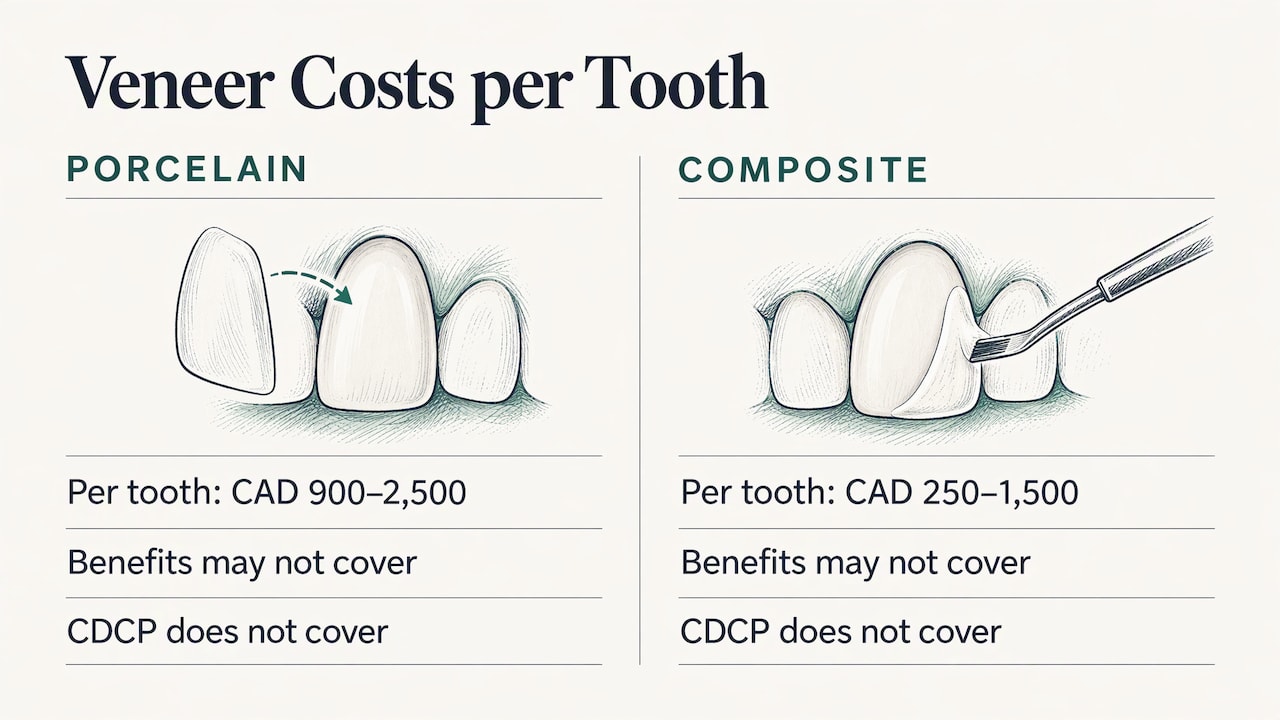
Veneers are generally considered cosmetic, so they may not be covered by a dental benefits plan, according to the Canadian Dental Association. The same cost guide states the Canadian Dental Care Plan does not cover them. We do not publish veneer prices, so the dependable number is a written estimate after your exam, listing the teeth, the material and the number of visits.
Our perspective
We think the best veneer is the one that takes the least from your natural teeth while still doing what you came for. That is why we start with your mouth, not a product.
Our approach to dentistry is whole-body and evidence-based, and it looks at root causes. For veneers, that means checking gum health, bite and grinding before anything is bonded, and treating what needs treating first. Some smiles are perfect candidates for no-prep veneers. Others are better served by traditional veneers, aligners or restorative work, and we will say so plainly.
We also know many people avoid the dentist because of anxiety or past experiences. Our environment is judgment-free, and sedation options are available. A treatment that often needs little or no anesthetic can be a gentle way into cosmetic care.
Deane
Start with a consultation at Vigée Dental
Our Calgary clinic offers no-prep veneers alongside porcelain veneers, whitening and aligners, so your recommendation is based on your teeth and not on the only option we happen to provide. You can also read more on our veneers in Calgary page, or book through our main site.

If dental anxiety has kept you away, tell us when you book and we will plan your visit around your comfort.
FAQ
Are no-prep veneers painful?
Because little or no enamel is removed, many patients need little or no anesthetic, and the Bioinformation review notes the additive approach minimizes the need for it. Comfort varies by person and by case. If you are anxious, ask about our sedation options when you book.
Are no-prep veneers worth the money?
They are worth considering if your teeth are healthy and you want a subtle change while keeping your enamel. Reviews report high survival in well-selected cases. If your teeth need bigger changes, a traditional approach may give a better result, and an exam will tell you which applies.
Do no-prep veneers last as long as traditional ones?
In the 2026 review, no-prep veneers averaged 97% survival against 92% for conventional, though study methods differ. Lifespan depends on the case, your bite, your habits and your hygiene care.
Can any dentist place them?
The Journal of Osseointegration review calls the technique operator-sensitive, so experience and careful planning matter. Ask who will place yours, how they decide between no-prep and traditional, and whether you can preview the result.
Sources
- Conventional Versus Minimally Invasive Veneers (systematic review, 2023)
- No-preparation and conventional veneers in esthetic dentistry (Bioinformation, 2026)
- No-preparation ceramic veneers: a systematic review (Journal of Osseointegration, 2018)
- Bonding & Veneers, Canadian Dental Association
- Veneers Cost in Canada 2026