
A chipped tooth is usually repairable, and the sooner a Calgary dentist looks at it, the more options you keep. Small chips are often smoothed or rebuilt with tooth-coloured material in one visit. Bigger breaks may need a crown or root canal treatment. At Vigée Dental, our emergency dentistry and restorative dentistry services cover the whole path, from the first sore edge to a finished, natural-looking repair, with sedation available if the idea of the chair makes you tense.
TL;DR
- Save any broken pieces, rinse gently, use a cold compress, and see a dentist promptly, especially if you have pain, bleeding or sensitivity.
- The repair depends on the damage: smoothing, bonding, a veneer, a crown, or root canal treatment plus a crown for deeper breaks.
- The Alberta Dental Association’s 2025 fee guide lists front-tooth bonded fillings from $166.47, but each dentist sets their own fees.
- The Canadian Dental Care Plan covers some restorations but not veneers or cosmetic treatment, so ask about coverage before you book.
- If dental anxiety is why you have put this off, sedation options exist, and a judgment-free visit is a normal request.
Table of Contents
- What to do in the first hours after chipping a tooth
- When a chip is urgent and when it can wait a few days
- How a dentist assesses a chipped tooth
- Repair options compared: smoothing, bonding, veneers, crowns
- What chipped tooth repair costs in Calgary
- Insurance and the Canadian Dental Care Plan
- If the dentist’s chair is what worries you
- Protecting the repair and the rest of your teeth
- Perspective
- Book your chipped tooth assessment
- FAQ
- Sources
What to do in the first hours after chipping a tooth
The first steps are simple, and they protect both the tooth and your options.
- Find the pieces. Alberta Health Services advises that you take any tooth fragments to the dentist, who can check that nothing is left in a wound, swallowed or breathed in.
- Rinse gently. Warm salt water (half a teaspoon of salt in a cup of warm water) is the Alberta Health Services suggestion for a sore mouth after an injury, from the same page.
- Manage swelling. A cold cloth or ice on the cheek or gum helps with pain and swelling. If the inner part of the tooth (the pulp, where the nerve lives) is exposed, avoid hot and cold near that tooth.
- Cover sharp or exposed areas. For an exposed pulp, Alberta Health Services says drugstore temporary filling material can cover the broken area until you are seen.
- Keep the fragment moist. The Ontario Dental Association suggests keeping a chipped piece in cold milk.
- Call a dentist. The same association notes that fast action can save the tooth, prevent infection and reduce the need for extensive treatment.
If you have swelling in the face, a fever, a bad taste or pus near the tooth, those are signs of infection. Alberta Health Services lists signs of infection as a reason to seek immediate care, so call a dentist the same day, or go to urgent care or an emergency department if you cannot reach one. Our own guide to what to do after a chipped, cracked or broken tooth walks through the same decisions, and our page on who to call for an emergency dentist in Calgary covers urgent situations.
When a chip is urgent and when it can wait a few days
Not every chip is an emergency, but it is hard to judge one from the mirror. Here is a practical way to sort it.
Book a same-day or next-day visit if:
- the tooth hurts when you bite, or reacts sharply to hot, cold or air
- you can see a pink or reddish spot inside the chip
- the break is jagged and cutting your tongue or cheek
- there is bleeding that does not settle
- a large part of the tooth is missing, or the tooth feels loose
A visit within the next several days is reasonable if the chip is small, smooth to your tongue, and painless. Even then, a painless chip is worth having checked. Small cracks can run below the gumline where you cannot see them, and a tooth with a rough edge is more likely to trap plaque and catch on food.
One point trips people up: pain stopping is not always good news. If a deep chip hurts and then goes quiet, the nerve may be struggling. That is another reason to be seen rather than wait it out.
How a dentist assesses a chipped tooth
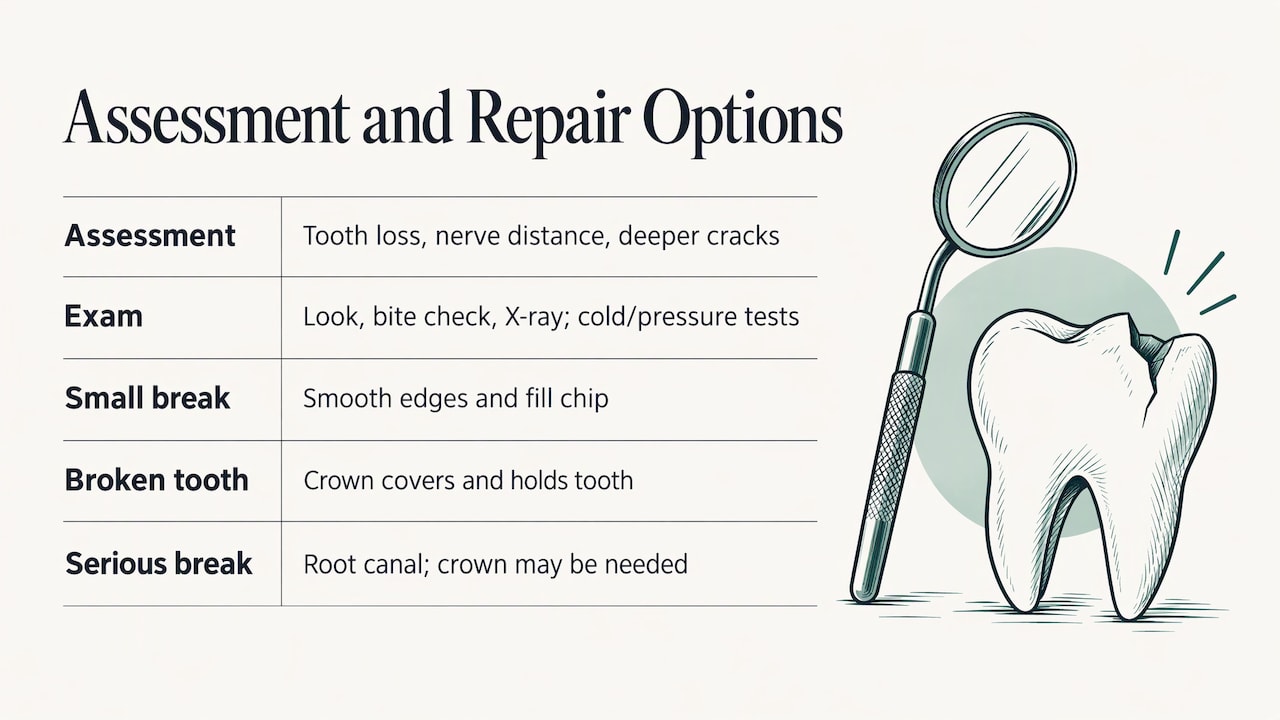
A good assessment answers three questions: how much tooth is gone, how close the break is to the nerve, and whether there is a crack running deeper than the visible chip.
Typically this means a conversation about when and how it happened, a look at the tooth and the bite, and an X-ray to see the root and the surrounding bone. The dentist may also test the tooth for sensitivity to cold and pressure.
Then comes the choice of repair. Alberta Health Services says a dentist may smooth jagged edges and fill in the chipped-off part, or put a crown on a broken tooth to cover and hold it together. The Ontario Dental Association adds that small breaks may be fixed with a filling, serious breaks may need a root canal, and the tooth may need a crown. Most chipped or broken teeth, it says, can be saved.
Repair options compared: smoothing, bonding, veneers, crowns
The Canadian Dental Association’s glossary gives the plain definitions: bonding is composite resin applied to change a tooth’s shape or colour, a crown is a covering for a weakened, severely damaged or chipped tooth, and a veneer is a plastic or porcelain facing bonded to a tooth to improve its appearance. Here is how those play out for a chip.
| Option | Best suited to | What it involves | Typical visits |
|---|---|---|---|
| Smoothing (recontouring) | Tiny chips, a rough edge | Polishing the edge so it no longer catches | One |
| Bonding | Small to medium chips on front or back teeth | Tooth-coloured resin built up and shaped to match | Usually one |
| Veneer | A chipped front tooth where colour, shape or several teeth are also a concern | A thin porcelain facing, which may be a no-prep style that keeps most of the natural tooth | Typically more than one |
| Crown | Large breaks, weakened teeth, teeth with a crack | A cap that covers the whole visible tooth | Typically more than one |
| Root canal, then crown | A break that reaches the pulp | Treating the nerve space, then rebuilding and protecting the tooth | More than one |
Bonding for most everyday chips
For a modest chip, bonding is the usual starting point because it adds material rather than removing much tooth. We explain what dental bonding fixes and who it suits on its own page. The shade is matched to the neighbouring teeth, so the repair blends in.
Veneers when the smile is part of the picture
If the chipped tooth is at the front and you have long been unhappy with its shape, colour or the gaps beside it, a veneer can fix the chip and the cosmetic concern in one plan. We offer porcelain and no-prep veneers in Calgary, and our veneer consultation guide explains what to expect and what to ask. Our First Look page shows how you can preview veneers on your own smile before deciding.
Crowns and root canals for deeper damage
When a large portion is missing, a crown restores and protects what is left. If the break has reached the nerve, endodontic therapy removes the damaged tissue and relieves the pain, and a crown usually follows. You can read what to expect from root canal therapy and how to recognize signs you need a root canal. A root canal has a reputation it does not deserve: its purpose is to end the pain from an injured nerve and keep your own tooth.
What chipped tooth repair costs in Calgary
Prices vary by clinic, and in Alberta every dentist sets their own fees. The most useful public reference is the Alberta Dental Association’s fee guide, which dentists use as a starting point. In its 2025 abbreviated guide for general dentists, reference fees include:
| Service (2025 guide) | Reference fee |
|---|---|
| One-surface bonded filling, permanent front tooth | $166.47 |
| Two-surface bonded filling, permanent front tooth | $199.26 |
| Porcelain-fused-to-metal crown | $1,026.34, plus laboratory charges |
| Conscious sedation with nitrous oxide | $102.01 per two units of time |
These are guide figures for 2025, not a quote, and the guide is updated by the association from year to year. We do not publish fixed prices for our services, because the right repair is set by your exam. After your assessment, you receive a plan that sets out the recommended treatment, so you know what to expect before you commit.
What moves the price:
- Size and surfaces. A chip that involves more than one surface of the tooth costs more than a small edge repair, as the one- and two-surface fees above show.
- Material and laboratory work. Crowns and veneers are made in a lab, which adds to the fee.
- Underlying treatment. A root canal or a build-up under a crown is added if the damage runs deeper. For context, we break down root canal costs in Calgary separately.
- Sedation. If you want nitrous oxide, it is billed by time, as the guide shows.
Insurance and the Canadian Dental Care Plan
If you have private insurance through work, ask your plan administrator whether the repair is a basic restorative service or a major one, and what percentage applies. Plans differ, and so do annual maximums.
If you are covered by the Canadian Dental Care Plan (CDCP), the federal program, the Dental Benefits Guide (version effective December 7, 2025) sets out the rules that matter here:
- Restorations are eligible once per tooth surface in any 24-month period.
- Crowns need preauthorization, with limits of 4 in 120 months per client and 1 in 96 months per eligible tooth.
- Crowns done to improve aesthetics, or to treat chipping on minimally restored teeth, are not considered for coverage.
- Veneers in composite or ceramic and cosmetic treatment such as teeth whitening are outside the plan.
In plain terms, a functional filling repair may be covered, while a cosmetic upgrade is something you would plan for separately. Benefit rules are revised from time to time, so check the current guide on the Government of Canada site and confirm your own eligibility before treatment. Our team can help you understand what your repair involves so that you can compare it with what your plan allows.
If the dentist’s chair is what worries you
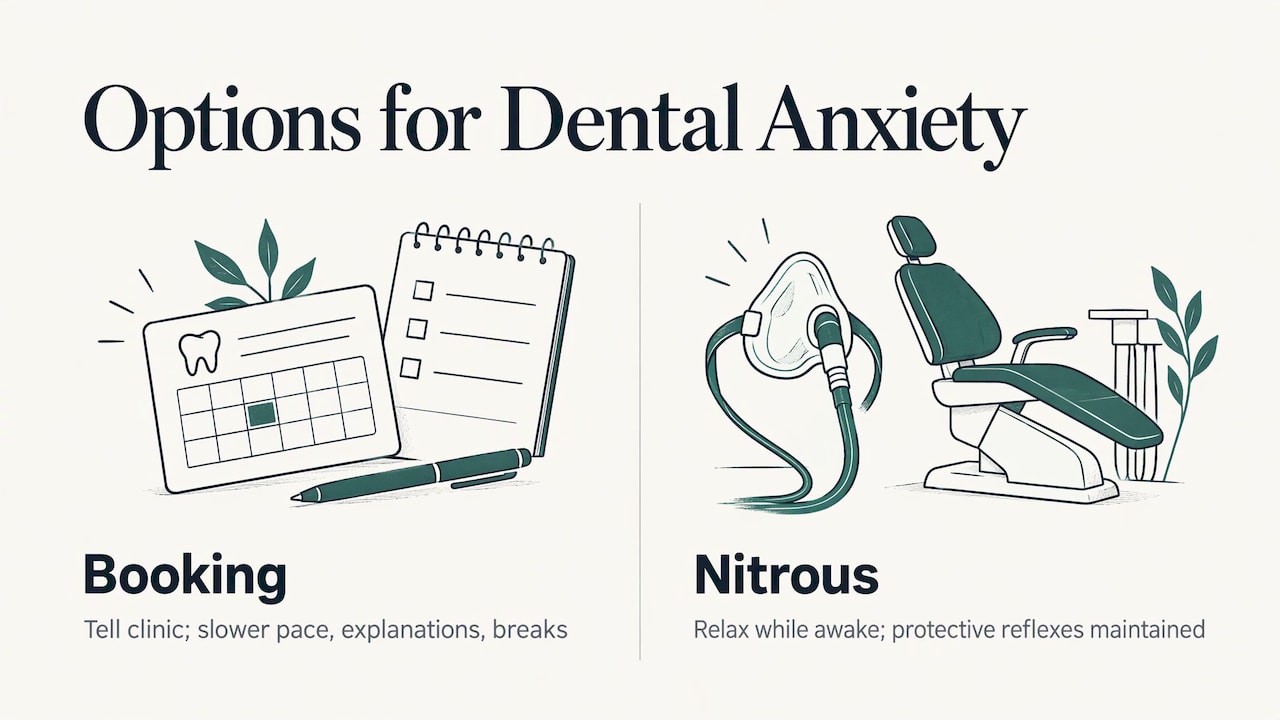
Putting off a chipped tooth because of dental anxiety is common, and it often makes the repair bigger later. Tell the clinic about it when you book. That one sentence changes how your visit is run: slower pacing, clear explanations, breaks when you need them.
Sedation is another option. The Alberta Dental Association’s guide describes conscious sedation with nitrous oxide as a controlled state that lets anxious or nervous patients of all ages relax while remaining awake, with protective reflexes maintained. Sedation dentistry is part of what we offer at Vigée Dental, and a repair such as bonding is a short appointment in which it can make a real difference.
Protecting the repair and the rest of your teeth
A chip is often a symptom. Teeth chip because of an old large filling, a bite that puts force on one spot, grinding at night, biting hard objects, or a sports knock. Fixing the tooth without understanding why it broke invites a repeat.
After a repair:
- Avoid biting ice, hard candy, pen caps and packaging with your front teeth.
- Keep up with hygiene visits so the margins of the repair stay clean. Our dental hygiene and cleanings service supports that.
- If you clench or grind, raise it at your exam. Our proactive dentistry approach looks at causes, not only the visible damage.
- If several teeth are worn, chipped or heavily restored, a broader plan such as full-mouth rehabilitation may be worth discussing.
For children who chip a tooth during sport, mouthguards and an early visit matter. Pediatric dentistry is part of our services too.
Perspective
Most people who come to us with a chipped tooth are not worried about the chip. They are worried about what it will cost, whether it will hurt, and whether someone will make them feel bad about waiting. We think all three deserve a straight answer.
Our approach is to look at why the tooth broke, not only at the piece that is missing. That is what we mean by addressing root causes rather than treating symptoms. A bite that overloads one tooth, a worn old filling or night-time grinding will keep breaking teeth if no one deals with it.
We also believe the repair should suit you. A small chip may need only careful bonding. A chipped front tooth you have disliked for years might be the moment to consider veneers. A damaged back tooth might need restorative work to last. Your exam tells us which, and you decide with the information in front of you.
And if the chair is the hard part, say so. Comfort and sedation are part of how we care for patients, and a judgment-free visit is the standard we hold ourselves to.
Deane
Book your chipped tooth assessment
If you have chipped a tooth in Calgary, Vigée Dental can see you for an assessment and recommend the repair that fits the damage, from restorative work to veneers, with sedation available for anxious patients. For urgent pain, start with our emergency dentistry page. For a cosmetic repair, see our cosmetic dentistry services, or book through vigeedental.ca.

FAQ
What is the cheapest way to fix a chipped tooth?
For a small chip, smoothing the edge or a bonded filling is usually the most economical repair. The Alberta Dental Association’s 2025 guide lists a one-surface front-tooth bonded filling at $166.47, though each dentist sets their own fees. Leaving a chip untreated can lead to a larger repair later, so an early exam is often the better value.
Can a chipped tooth be repaired in one visit?
Often, yes. Smoothing and bonding are commonly completed in a single appointment. Crowns and veneers are made in a lab, so they usually take more than one visit, and a break that reaches the nerve may need root canal treatment first.
Is a chipped tooth a dental emergency?
It is urgent if you have pain, bleeding, an exposed pink or red area, swelling or signs of infection. A small, painless chip can be booked within a few days, but it is still worth having checked, since cracks may extend below the gumline.
Does the Canadian Dental Care Plan cover chipped tooth repair?
The plan covers restorations once per tooth surface in any 24-month period, and crowns with preauthorization and limits. Crowns done to improve aesthetics or to treat chipping on minimally restored teeth, and veneers, are not covered. Check the current Dental Benefits Guide and your own eligibility before booking.
What if I am anxious about getting a chipped tooth fixed?
Tell the clinic when you book so your visit can be planned around your comfort. Nitrous oxide sedation keeps you awake while helping you relax, and we offer sedation dentistry at Vigée Dental.
Sources
- Broken Tooth: Care Instructions, Alberta Health Services
- Mouth and Dental Injuries, Alberta Health Services
- Dental Emergencies, Ontario Dental Association
- Dental Terms, Canadian Dental Association glossary
- Abbreviated Alberta Dental Fee Guide for General Dentists, 2025
- Canadian Dental Care Plan Dental Benefits Guide, Government of Canada
Recommended
- Chipped, Cracked Or Broken Tooth: What To Do Next
- Dental Bonding In Calgary: What It Fixes And Who It Suits
- Restorative Dentistry In Calgary
- Root Canal Cost In Calgary: 2026 Fees And What You Pay
- Smile Makeover in Calgary: Options, Steps and Timeline
- Pediatric Dental Emergency: What to Do in the First Minutes