
Sensitivity is a symptom, not a diagnosis. The right treatment depends on why your teeth react to cold, heat or sweets, and that is what a dental exam finds out. Desensitizing toothpaste is a reasonable first step for mild cases. If the pain lingers, or if a worn root, a crack or a failing filling is behind it, a dentist can seal, bond or protect the tooth. At Vigée Dental in Calgary, a new patient exam is where we start.
TL;DR
- Mild sensitivity to hot, cold or sweet often responds to a desensitizing toothpaste used daily and a soft brush.
- Moderate to severe sensitivity can point to a cracked tooth, a cavity or a lost filling, so it deserves an exam.
- Dentists can apply fluoride varnish, bond exposed roots, make a night guard for grinding or treat gum recession.
- Pain that lasts over an hour, or does not ease after a few weeks of toothpaste, means book a visit.
- Treating the cause, not just the twinge, is what keeps sensitivity from returning.
Table of Contents
- What is actually happening in a sensitive tooth
- What you can do at home first
- When sensitivity needs a dentist
- What a dentist can do about tooth sensitivity
- Can sensitivity be fixed permanently?
- If a dentist visit makes you nervous
- Book a sensitivity exam in Calgary
- FAQ
- Sources
What is actually happening in a sensitive tooth
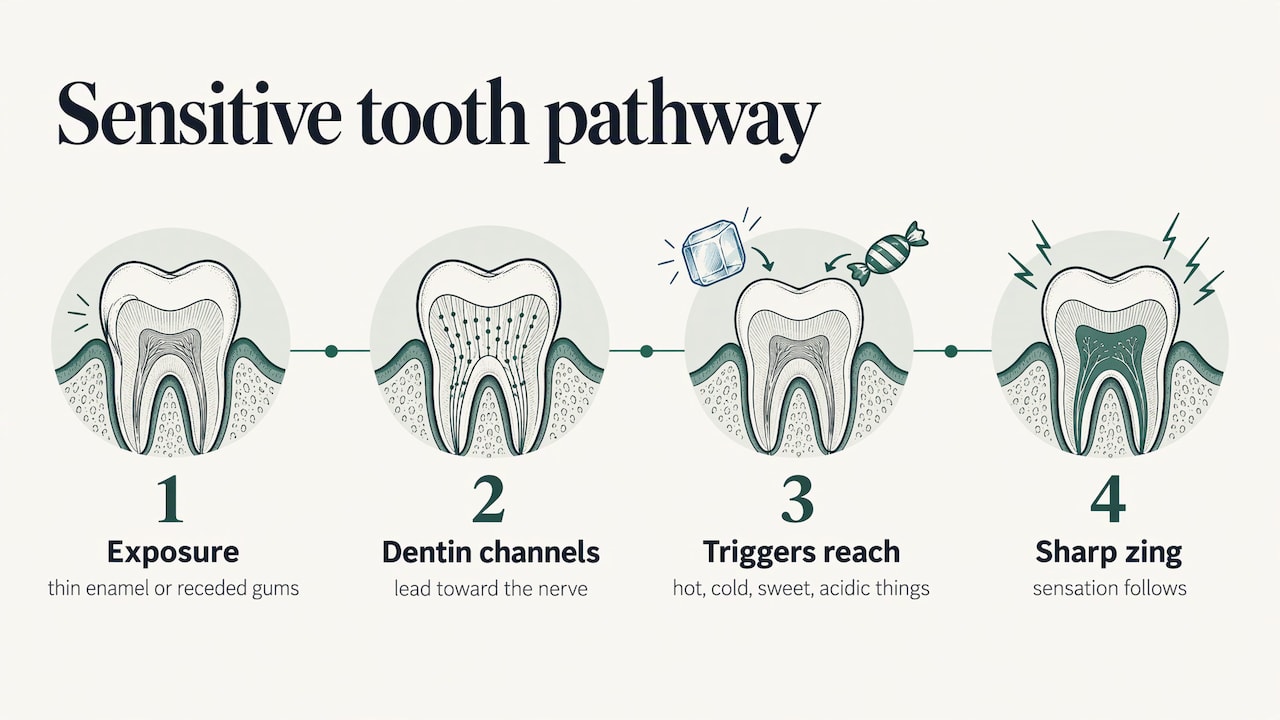
Each tooth has a hard outer shell of enamel over a softer layer called dentin. Dentin is full of microscopic channels that lead toward the nerve. When enamel wears thin or gums pull back and expose the root, hot, cold, sweet or acidic things reach those channels and you feel a sharp zing.
The University of Alabama at Birmingham School of Dentistry lists the common reasons: enamel wear, gum recession, erosion from acidic foods and drinks or acid reflux, and low saliva flow. The Ontario Dental Association adds gum disease, teeth clenching, worn fillings and cracks.
That list matters because the same feeling can come from very different problems. HealthLink BC explains that mild sensitivity can come from receded gums or a worn tooth, while moderate to severe sensitivity can mean a cracked tooth, a cavity or a lost filling. Seeing a dentist in those cases can prevent the tooth from dying.
What you can do at home first
For mild sensitivity that has just started, these steps are sensible and low risk.
- Switch to a desensitizing toothpaste and use it every day. A Canadian dental consensus panel in the Journal of the Canadian Dental Association recommends these toothpastes as the first-line treatment. HealthLink BC also suggests rubbing a small amount on the sensitive spot with a clean finger two to three times a day.
- Brush gently with a soft brush. The American Dental Association suggests short circular strokes at a 45-degree angle, daily flossing, and a straw for hot, cold or acidic drinks.
- Ease off acidic and very hot, cold or sweet foods while the tooth settles.
- Skip over-the-counter whitening products, which the same ADA guidance advises against when teeth are sensitive.
- Floss gently. Aggressive flossing near exposed roots can make things worse.
For a toothache, HealthLink BC recommends an ice pack rather than heat. It also mentions short-term benzocaine gel for adults; check with a doctor before using any mouth-numbing product on a child.
What the toothpaste ingredients do
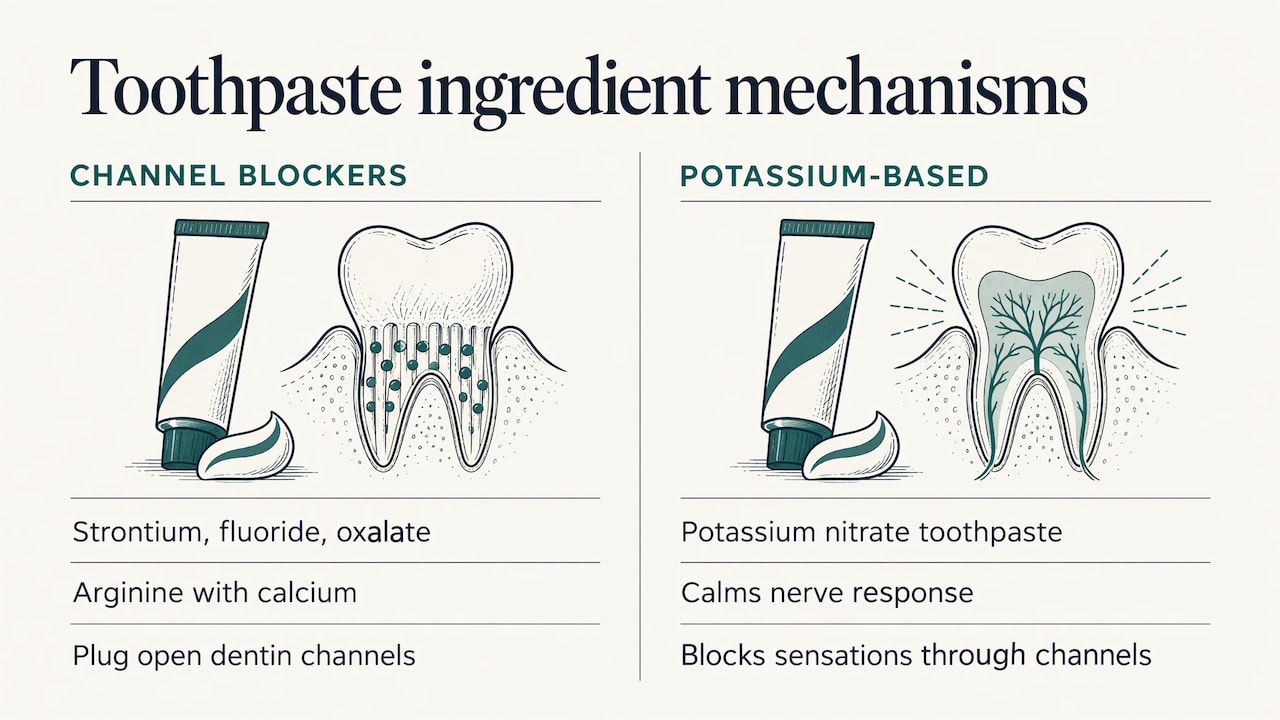
Not every ingredient works the same way. A 2020 evidence-based overview in PMC reports that strontium salts, fluoride, oxalate and arginine with calcium have been shown to plug the open channels in dentin. Potassium-based products work differently, calming the nerve response, and the ADA notes that potassium nitrate toothpastes help block the sensations travelling through those channels. For a plain-language summary of how these ingredients are studied, see this overview of oral health ingredients.
In Canada, sensitivity toothpastes can be licensed by Health Canada. One licensed product contains 5.0% potassium nitrate and 1.1% sodium fluoride and is approved for adults and children 12 and older. Follow the label, and ask us about the right fluoride toothpaste for younger children.
Give it time. Relief usually builds over days to a couple of weeks of consistent use, which is why the ODA sets a few weeks as the checkpoint.
When sensitivity needs a dentist
The Ontario Dental Association says to tell your dentist about any sensitivity to hot, cold or sweet, and to call right away if:
- the tooth is also sensitive to pressure,
- there is no improvement after a few weeks of desensitizing toothpaste,
- pain lasts longer than an hour, or
- the gums around the tooth change colour.
HealthLink BC advises booking within one to two weeks for a toothache and seeking care sooner if symptoms get worse. A quick twinge that fades is generally not serious, according to the American Association of Endodontists. They also say sensitivity after dental work can take two to four weeks to settle, and that persistent or worsening pain should be checked. If this describes you after a recent filling, our guide on pain after a filling walks through what is normal.
If the pain is throbbing, spontaneous or wakes you at night, do not wait. Call us for emergency dental care.
What a dentist can do about tooth sensitivity
Treatment follows the cause. The ODA’s list of professional options, along with guidance from Mayo Clinic, gives a clear picture.
| Cause | Typical professional approach |
|---|---|
| Thin enamel, mild exposure | Professional desensitizing agents, fluoride gel or varnish |
| Exposed root from gum recession | Bonding with tooth-coloured resin, or gum treatment |
| Worn or failed filling | Replacing the restoration |
| Cracked or heavily worn tooth | Filling, inlay, crown or veneer |
| Grinding or clenching | A customized night guard |
| Deep, unresponsive pain | Root canal therapy |
Fluoride and desensitizing agents
The ODA describes fluoride varnish applied at the dental office, repeated every two or three months. A 2026 review in the Journal of Conservative Dentistry and Endodontics describes 5% sodium fluoride varnish forming a mineral that partly seals the channels, and glutaraldehyde-based products that give immediate, lasting relief. Our dental hygiene and cleaning visits are a natural time to discuss these.
Bonding and restorations
The ODA calls bonding a more permanent fix: tooth-coloured composite resin is applied to exposed roots for long-lasting protection. The PMC overview notes that resin composite or glass ionomer fillings, or a crown or veneer, can give lasting relief when erosion or abrasion caused the problem. Our restorative dentistry work covers these repairs.
Treating gum recession
When gums have pulled back, the root is exposed and sensitivity follows. The causes include plaque and tartar, harsh brushing, tobacco and some medications, according to the Journal of the American Dental Association. Catching it early gives you more options. Read our guides to gum recession and gum recession treatment.
Grinding and clenching
Clenching wears enamel and can crack teeth. The ODA lists a customized mouth guard as the answer when grinding is the cause. See our guide to the night guard for teeth grinding, and if you also have jaw pain or headaches, our TMJ symptoms article explains the link.
When the nerve is involved
When conservative, sealing and restorative steps do not settle the pain, the 2026 review describes endodontic therapy as the last resort. Learn the signs you need a root canal and what to expect.
Can sensitivity be fixed permanently?
Often it can, once the cause is dealt with. Bonding over exposed roots is described by the ODA as long-lasting. Consensus guidance in the JCDA says causes should be removed or modified, gentler reversible steps tried before irreversible ones, and follow-up kept. The 2026 review describes patients whose symptoms fully resolve moving back to routine preventive care.
Prevention is the same set of habits the ODA lists: keep teeth clean, use fluoridated and desensitizing products, brush softly, avoid tobacco, and cut back on acidic foods and sugary snacks. Mayo Clinic adds rinsing with water after acidic foods.
Treatments differ in how long they last. Fillings and bonding can wear over time and gum procedures vary in outcome, so the plan depends on how deep the problem is, how the tooth looks and how you responded to earlier steps. That is why we review and adjust rather than apply one fix.
If a dentist visit makes you nervous
Putting off an appointment because of anxiety is common, and sensitivity tends to get worse while you wait. We offer sedation dentistry and a judgment-free approach, so you can have the cause found without dreading the chair.
Our view
Sensitivity is a message from the tooth. A toothpaste can quiet it, but it does not tell you why it started. We look at the whole picture: your gums, your bite, whether you clench at night, what you eat and drink, and the state of your existing fillings. Our approach is evidence-based and aims at the root cause rather than the symptom.
That matters most for people who have been living with a zing for months. A quick exam can turn guesswork into a plan, and many plans are simple: a professional fluoride treatment, a bonded root, a night guard. We explain each option plainly and go at your pace.
Deane
Book a sensitivity exam in Calgary
If toothpaste has not settled things, or you are not sure what is causing it, our team at Vigée Dental offers a new patient exam, preventive care, restorative dentistry, sedation and emergency dentistry under one roof. Tell us what triggers the pain and when it started, and we will work out the cause with you.

Book your visit at Vigée Dental. If your sensitivity is related to cold drinks, our guide on why a tooth is sensitive to cold is a good next read.
FAQ
How long does it take for sensitive teeth to calm down?
With a desensitizing toothpaste used daily, many people notice a change within a couple of weeks. The Ontario Dental Association says to see a dentist if there is no improvement after a few weeks. Sensitivity after a filling or other treatment can take two to four weeks to settle.
Can I use whitening products if my teeth are sensitive?
The American Dental Association advises avoiding over-the-counter whitening products while teeth are sensitive. If you want a brighter smile, ask us about professional teeth whitening once the cause of the sensitivity is known.
Is tooth sensitivity a sign of a cavity?
It can be. HealthLink BC notes that moderate to severe sensitivity may signal a cavity, a cracked tooth or a lost filling. Mild sensitivity can come from receded gums or wear. An exam tells the two apart.
Can children get sensitive teeth?
Yes. The licensed Canadian sensitivity toothpaste noted above is for ages 12 and over, and HealthLink BC says to ask a doctor before using mouth-numbing products on children. Our pediatric dentistry team can check what is causing it.
Sources
- Toothache and Gum Problems, HealthLink BC
- Tooth Sensitivity, Ontario Dental Association
- Sensitive Teeth: What Could Be Causing the Pain?, UAB School of Dentistry
- Consensus-Based Recommendations for the Diagnosis and Management of Dentin Hypersensitivity, JCDA
- Tips to reduce tooth pain caused by sensitivity, American Dental Association
- Pathogenesis, diagnosis and management of dentin hypersensitivity, PMC
- Health Canada licensed natural health product record
- Tooth Pain, American Association of Endodontists
- Sensitive teeth: What treatments are available?, Mayo Clinic
- Dentin hypersensitivity, an enigma revisited, Journal of Conservative Dentistry and Endodontics
- Preventing and treating tooth sensitivity, Journal of the American Dental Association