
A root canal in Calgary is priced by the number of canals in the tooth, and the Alberta Dental Association’s 2026 suggested fee for an uncomplicated root canal runs from $795.45 for one canal to $1,354.65 for three. Your actual bill depends on the tooth, how complicated it is, and what the tooth needs afterward, usually a crown. At Vigée Dental we offer root canal therapy with sedation available for patients who dread the chair, and we would rather you see the whole cost picture before you book than be surprised at the front desk.
TL;DR
- The 2026 Alberta Dental Fee Guide suggests $795.45 for a one-canal root canal, $1,158.35 for two canals and $1,354.65 for three. Each dentist sets their own fees, so these are a reference point, not a quote.
- Front teeth cost the least and molars the most, because molars have more canals. Curved canals, retreatment and severe infection can add to the price.
- Budget for the extras: the exam, X-rays and, most often, a crown on the treated tooth.
- The Canadian Dental Care Plan (CDCP) and private insurance can cover part of the treatment. Coverage rules differ by tooth and by whether it is a first treatment or a retreatment.
- Saving the tooth is generally the more cost-effective route over time than pulling it and replacing it.
Table of Contents
- What a Calgary root canal costs by tooth
- Why two root canals can cost very different amounts
- The extras that land on the same bill
- How insurance and the CDCP change what you pay
- Is it cheaper to pull the tooth?
- Planning for the visit if you are nervous
- Perspective: what we tell patients about cost
- Booking a root canal in Calgary
- FAQ
- Sources
What a Calgary root canal costs by tooth
The most useful published number for Calgary is the Alberta Dental Fee Guide. It is produced each year by the Alberta Dental Association, and it lists suggested fees for general dentists across the province. The Association states that every dentist sets their own fees, so the guide’s figures may not match the cost of your specific treatment. Think of it as the map’s scale, not the price on your invoice.
Here are the 2026 suggested fees for an uncomplicated permanent root canal, with the 2025 figures beside them for comparison (2026 guide, 2025 guide):
| Tooth type (typical) | Canals | Fee code | 2026 suggested fee | 2025 suggested fee |
|---|---|---|---|---|
| Front tooth | 1 | 33111 | $795.45 | $761.19 |
| Premolar | 2 | 33121 | $1,158.35 | $1,108.48 |
| Molar | 3 | 33131 | $1,354.65 | $1,296.32 |
The year-over-year rise works out to about 4.5% on each line. The guide is revised annually, so check the Alberta Dental Association’s page for the edition in force when you book.
A few things in that table are worth reading carefully:
- “Uncomplicated” is the key word. The listed fees cover a straightforward case. A tooth with unusually shaped canals, an old filling that must be removed, or an infection that needs extra visits falls outside it.
- Canal count is a typical guide, not a rule. Your dentist confirms the number of canals from X-rays and, during treatment, from what they find inside the tooth. A premolar can have one canal or two, and some molars have four.
- The fee is for the root canal only. The tooth is not finished when the canals are cleaned and sealed. See the next sections for what comes after.
You may also see other numbers online. Some websites quote broad Canadian ranges, such as $300 to $1,500, and others quote ranges for British Columbia cities. They are useful for a sense of scale, but for Calgary the Alberta guide is the better yardstick because it is built for Alberta practices and updated every year.
Why two root canals can cost very different amounts
The American Association of Endodontists (AAE), the professional body for root canal specialists, explains that front teeth are generally less expensive to treat because they typically have a single canal, while molars have multiple canals and cost more. The same page lists curved or narrow canals, retreatment of a tooth treated before, and severe infection as factors that can raise the cost further.
In plain terms, the price follows the time and skill the tooth demands:
- Which tooth. More canals mean more cleaning, shaping and sealing. This is why the fee guide steps up from one to three canals.
- How complicated the anatomy is. A narrow or curved canal is slower and harder to clean thoroughly.
- Whether it is a first treatment or a retreatment. Redoing a root canal that has become reinfected usually involves removing the old filling material before starting again.
- How advanced the infection is. A tooth with a spreading infection may need more than one visit, and sometimes medication placed in the tooth between visits.
- What restoration follows. The AAE notes that the type of restoration needed afterward also shapes the total cost.
If your tooth hurts when you bite, swells, or has a pimple-like bump on the gum, get it looked at promptly. A tooth that is infected rarely gets cheaper by waiting. We offer emergency dentistry for exactly those days.
The extras that land on the same bill
People often ask about the root canal fee and are then surprised by the total. Several other line items can appear on the same account.
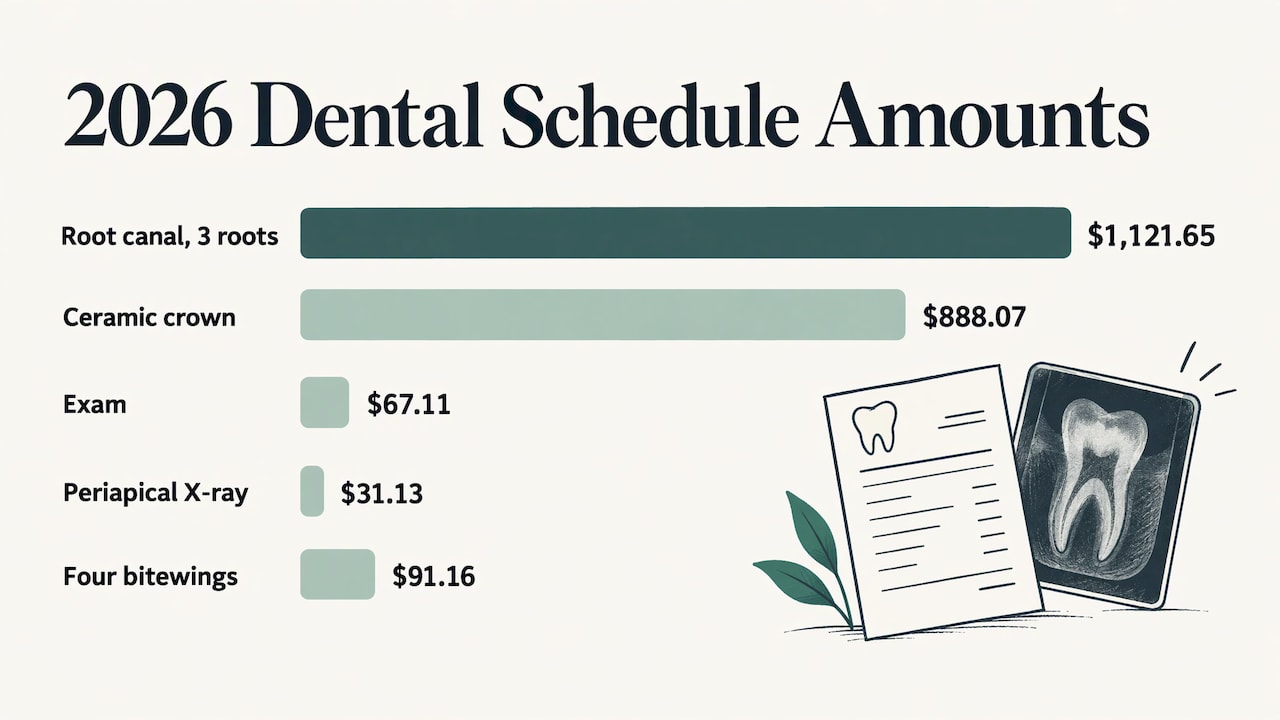
The 2026 Alberta Blue Cross Dental Schedule is a useful reference for these. It sets the maximum amounts payable under Alberta Blue Cross dental claims, and it lists (Alberta Blue Cross 2026 dental schedule):
| Item | 2026 maximum payment amount |
|---|---|
| Root canal therapy, 3 roots | $1,121.65 |
| Porcelain, ceramic or polymer glass crown | $888.07 |
| Recall or emergency examination | $67.11 |
| One periapical X-ray image (a single-tooth image showing the root and surrounding bone) | $31.13 |
| Four bitewing images (the X-rays you bite down on, showing upper and lower teeth together) | $91.16 |
These are insurer schedule amounts, not a clinic’s price list, and they differ from the fee guide’s suggested fees. A clinic’s own fees can sit above or below them.
A worked example
Say a lower molar needs a root canal and a crown. Using the Blue Cross maximums as a rough yardstick, the pieces would add up like this:
- Emergency or recall exam: $67.11
- One periapical X-ray: $31.13
- Root canal therapy, 3 roots: $1,121.65
- Porcelain or ceramic crown: $888.07
That totals $2,107.96. It is an illustration built from published schedule amounts, not a quote from any clinic. If your dentist’s root canal fee follows the Alberta fee guide’s three-canal figure of $1,354.65 instead, the root canal line alone is higher, and the total moves with it. The point is that the crown can cost nearly as much as the root canal itself, so the real question is the all-in number, not just the first line.
Why the crown matters
A tooth that has had a root canal has lost its internal blood supply and, in many cases, a large part of its structure to decay or an old filling. Back teeth in particular carry heavy chewing forces, and a crown, a custom cap that covers the whole tooth, is commonly placed to protect them. Front teeth with a small access hole and plenty of remaining structure are sometimes restored with a filling. Your dentist will tell you which applies, and we cover both under restorative dentistry.
How insurance and the CDCP change what you pay
Two kinds of coverage matter to Calgary patients: a private plan through work, and the federal Canadian Dental Care Plan.
Private insurance
Most employer plans pay a percentage of eligible endodontic treatment up to a yearly maximum. Many plans reimburse based on a fee guide or schedule, not on what the clinic actually charged, so a gap between the two comes out of your pocket. Our own article on the Alberta Dental Fee Guide and your bill walks through how that works, and there is a companion piece, the fee guide explained for patients.
Before treatment, ask for a written treatment plan with fee codes. Your insurer can then pre-estimate what it will pay. This takes a few days, and it takes the guesswork out of your share.
The Canadian Dental Care Plan
If you are eligible for the CDCP, root canals are in scope. Canada.ca lists endodontic services covered under the plan, including root canal treatments, pulpectomies (removal of the nerve tissue in the tooth), procedures to reduce infection and relieve pain, and retreatments of root canals previously completed. The same page says patients may have co-payments or additional charges, and that you may go ahead with services the plan does not cover and pay the provider directly.
The CDCP Dental Benefits Guide adds the rules that affect your planning:
- Preauthorization is not required for standard root canal treatment on front teeth, premolars, and first and second molars.
- Preauthorization is required for root canal retreatment, apicoectomy (a minor surgery that removes the tip of the root), retrofilling, and standard root canals on third molars (wisdom teeth).
- The lifetime limit is one retreatment, one apicoectomy and one retrofilling per tooth.
- Crowns have frequency limits: four crowns in any 120 months per client and one crown in any 96 months per eligible tooth. Cast metal, porcelain-fused-to-metal and porcelain or ceramic crowns need preauthorization, and a root-canal-treated tooth must have healed before a crown is requested.
The healing requirement means the crown often comes weeks or months after the root canal, so plan for two stages of cost and appointments, not one.
If you are unsure whether you qualify for the CDCP, check the Government of Canada’s pages for eligibility and how to apply. Whatever your coverage, a clear estimate with fee codes lets you and your insurer or the CDCP work out your share in advance.
Is it cheaper to pull the tooth?
The extraction fee on its own is lower than a root canal and crown, which is why the question comes up. The trouble is what happens after. A missing tooth leaves a gap that you may want to replace with a bridge, a partial denture or an implant, and each of those carries its own cost and its own follow-up care. The AAE says saving the natural tooth with a root canal is generally more cost-effective over time than extraction and replacement.
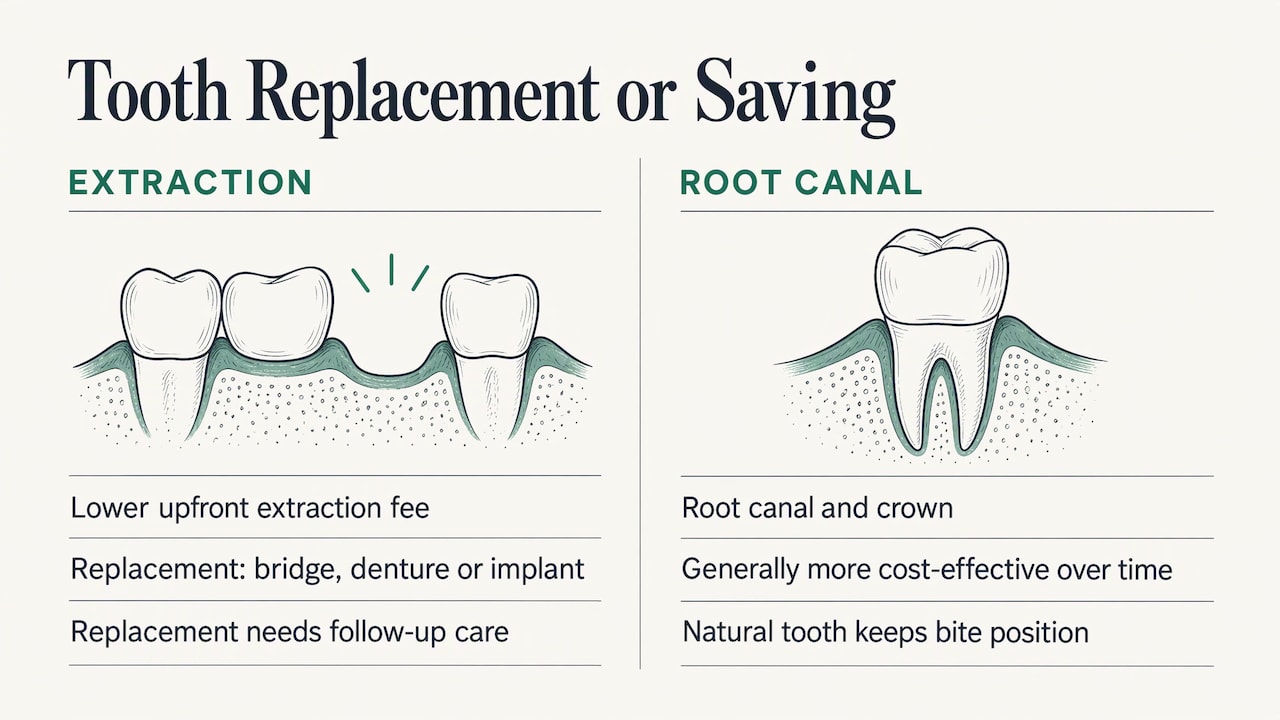
There is also a comfort and function side. Your natural tooth keeps its place in your bite and its connection to the surrounding bone. Teeth beside a gap can drift, and the opposing tooth can over-erupt. When a tooth can reasonably be saved, keeping it usually gives you the simplest long-term path. Your dentist will tell you honestly whether a given tooth can be saved after examining it and taking X-rays.
Planning for the visit if you are nervous
Fear of the procedure is the reason many people delay, and delay is what turns a modest problem into an expensive one. Modern root canal treatment is done under local anesthetic, so the tooth is numb, and the aim is to relieve pain, not cause it.
If the thought of the chair is the real obstacle, tell us when you book. We offer sedation dentistry, and you can read about the laughing gas, oral and IV options before you decide. Our approach is built to be judgment-free: you will not be lectured about how long it has been.
Perspective: what we tell patients about cost
We would rather you understand a root canal estimate than simply accept it. When a patient comes in with a painful tooth, the question about price is a fair one, and it deserves a full answer: the root canal, the exam and X-rays, and the crown or filling that protects the tooth afterward.
Our approach at Vigée Dental is whole-body and evidence-based. We look for the root cause of a problem and not only the symptom, because a tooth that is treated and then restored properly is a tooth that has the best chance of staying in your mouth for the long term. That is also usually the economical path, since repeated repairs and replacements add up.
For patients who feel anxious, we pair treatment with comfort: sedation options and a calm, personalized setting. A root canal does not have to be an ordeal, and the sooner we see a painful tooth, the simpler the care tends to be.
Deane
Booking a root canal in Calgary
If you have a tooth that aches, throbs with hot or cold, or hurts when you chew, the practical next step is an exam and X-rays so you get a diagnosis and a plan with the cost spelled out. Vigée Dental welcomes new patients, and our New Patient Exam is the usual starting point. You can read about root canal therapy at Vigée Dental and our wider endodontic therapy services, then book through our site.

We also treat the rest of the family, from pediatric dentistry to preventive care. Regular checkups and hygiene visits are how most root canals are avoided in the first place, because decay is caught while it is small. If you want to know what a routine visit costs too, see our guide to dental cleaning cost in Calgary.
FAQ
How much does a root canal cost in Calgary?
The 2026 Alberta Dental Fee Guide suggests $795.45 for a one-canal root canal, $1,158.35 for two canals and $1,354.65 for three. Dentists set their own fees, so your quote may differ. Ask for a written estimate with fee codes, including the crown.
Does the Canadian Dental Care Plan cover root canals?
Yes, for eligible patients. Canada.ca lists root canal treatments, pulpectomies and retreatments as covered endodontic services. Retreatments need preauthorization, and you may still face co-payments or additional charges. Check your eligibility with the plan.
Do I need a crown after a root canal?
Often, especially on back teeth that handle heavy chewing. Your dentist decides based on how much of the tooth remains. A crown is a separate cost, and under the CDCP a treated tooth must have healed before a crown is requested.
Is it cheaper to pull a tooth than fix it?
Pulling is cheaper on the day, but replacing the tooth with a bridge, partial denture or implant adds cost later. The American Association of Endodontists says saving the natural tooth is generally more cost-effective over time.
Sources
- Abbreviated Alberta Dental Fee Guide for General Dentists, 2026
- Abbreviated Alberta Dental Fee Guide for General Dentists, 2025
- Alberta Blue Cross 2026 dental schedule
- American Association of Endodontists: How Much Does a Root Canal Cost?
- Canadian Dental Care Plan: What is covered
- Canadian Dental Care Plan: Dental Benefits Guide