
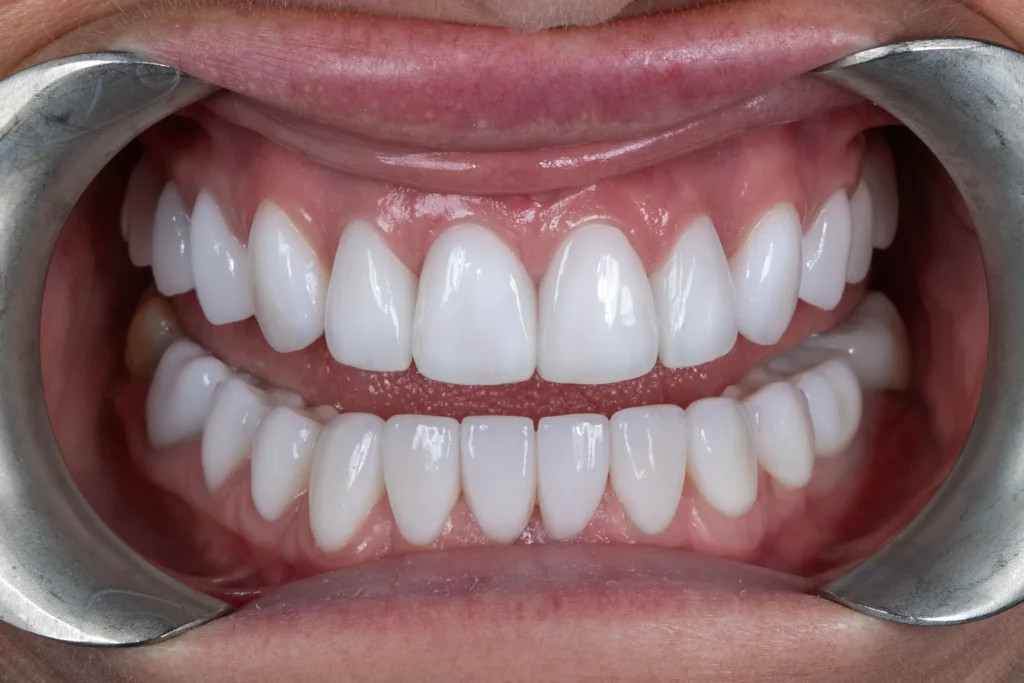
An overbite is how far your upper front teeth overlap your lower front teeth when you bite down, and a small overlap is normal. It becomes a problem when the overlap is deep enough to cause wear, gum irritation or jaw strain, and mild cases in adults can often be improved with clear aligners while larger jaw problems need a specialist referral.
What is an overbite?
When you close your back teeth together, your upper front teeth naturally sit slightly in front of and over your lower front teeth. That vertical overlap is the overbite. Cleveland Clinic describes a small overbite as normal and an overlap of more than 2 to 4 millimetres as an overbite that may need attention. A large overlap is often called a deep bite.
In a very deep bite, the lower front teeth can disappear almost completely behind the upper ones, and in some cases they bite into the gum behind the upper teeth.
Overbite vs overjet: what is the difference?
Many people say overbite when they mean teeth that stick out. Dentists separate the two:
- Overbite is vertical: how far the upper teeth cover the lower teeth.
- Overjet is horizontal: how far the upper front teeth sit forward of the lower ones. Cleveland Clinic notes the typical distance is about 2 millimetres. More than that is what people often call buck teeth.
You can have one without the other, or both together. The difference matters, because they are often caused and treated differently.
Other common bite problems
| Bite issue | What it looks like | What can help |
|---|---|---|
| Deep overbite | Upper front teeth cover much of the lower front teeth | Clear aligners for small overbites; specialist referral for deep or skeletal cases |
| Overjet | Upper front teeth sit well forward of the lower teeth | Orthodontic treatment, usually by referral when the jaws are involved |
| Crossbite | Some upper teeth sit inside the lower teeth when you bite | Aligners for a minor crossbite of one or two teeth; referral when the jaw is narrow or shifted |
| Open bite | Front teeth do not touch when the back teeth are together | Aligners for minor cases, often with tongue habit work; referral for larger cases |
| Crowded teeth | Teeth overlap or twist because there is not enough room | Clear aligners for mild to moderate crowding; referral for severe crowding |
A crossbite in particular is worth checking in children. As the Cleveland Clinic malocclusion guide describes, the upper teeth fit inside the lower teeth, which can make the jaw shift to one side to close.
What causes an overbite?
- Genetics. Jaw size and shape run in families. A lower jaw that is small or set back compared with the upper jaw is a common reason for a deep bite and overjet.
- Thumb sucking and pacifiers. Habits that carry on after about age 3 or 4 can push the upper front teeth forward and change how the jaws grow.
- Tongue thrust. A tongue that pushes forward against the teeth when you swallow puts steady pressure on them. Our article on tongue posture explains where the tongue should rest and why it matters for the bite.
- Worn or missing back teeth. When back teeth wear down or are lost, the bite can collapse and the front teeth overlap more.
- Grinding and clenching can wear teeth and, over time, change how they meet.
Problems an overbite can cause
A mild overbite often causes no trouble at all. A deeper one can lead to:
- Tooth wear. Front teeth that hit at the wrong angle can wear, chip or thin at the edges.
- Gum irritation. Lower teeth biting into the gum behind the upper teeth can cause soreness and recession.
- Jaw strain. A bite that does not fit together comfortably can contribute to jaw pain, clicking and headaches. Our guide to TMJ symptoms covers what to look for.
- Grinding damage. If you also clench or grind, a deep bite can add to the wear. A night guard for teeth grinding protects the teeth while the cause is worked out.
- Appearance. Some people dislike how much of their lower teeth is hidden, or how the lower face looks.
Overbite treatment for adults
For adults, the jaws have finished growing, so treatment focuses on moving the teeth rather than changing jaw growth.
Clear aligners for mild cases. Spark clear aligners suit minor bite refinements such as a small overbite, crossbite or open bite, as well as mild to moderate crowding or spacing. The trays move the teeth in small steps, and progress checks are every 6 to 10 weeks. Our article on how Spark aligners work covers wear time and refinements, and how long clear aligners take explains what affects the timeline.
Specialist referral for larger problems. When the overbite comes from a jaw size difference, or the bite is very deep, aligners alone may not be enough. In these cases we refer you to a specialist for assessment. Cleveland Clinic notes that some severe cases need jaw surgery in addition to orthodontic treatment.
Protecting what is there. Whatever the plan, worn teeth may need repair, and a night guard can limit further damage if you grind.
Overbite in children
Children are still growing, which can make some bite problems easier to guide. Cleveland Clinic notes that an overbite in children can often be corrected with orthodontics alone, while the bones are still developing.
That is why checking the bite is part of children’s checkups. Signs to mention to your dentist include:
- Thumb sucking or pacifier use that continues past the preschool years
- Upper front teeth that stick out well past the lower teeth
- A jaw that shifts to one side when your child closes
- Mouth breathing, snoring or a tongue that pushes between the teeth
If growth-related treatment could help, we refer your child to a specialist for assessment. When a tongue habit is involved, Vigée Dental’s in-office myofunctional therapist can work on tongue position and swallowing alongside that care.
At Vigée Dental, your exam includes a look at how your teeth meet. For mild overbites, crossbites and crowding, Spark clear aligners may be an option, and larger bite problems get a specialist referral. For children, our children’s dentistry visits include a look at growth and habits. Book an appointment online.
Frequently asked questions
Is it normal to have an overbite?
Yes. A small overlap of the upper front teeth over the lower front teeth is normal. It is the deep overbite, where the overlap is large, that can cause wear, gum irritation or jaw strain.
Can clear aligners fix an overbite?
For a small overbite caused by tooth position, often yes. Spark aligners suit minor bite refinements. A deep overbite caused by a jaw size difference usually needs a specialist assessment.
What is the difference between an overbite and a crossbite?
An overbite is how far the upper front teeth overlap the lower ones vertically. A crossbite is when some upper teeth sit inside the lower teeth when you bite, either at the front or the side.
Can an overbite cause jaw pain?
It can contribute. A bite that does not meet comfortably can strain the jaw muscles and joints, especially if you also clench or grind. Jaw pain has several possible causes, so it is worth having it checked.
Should a child’s overbite be treated early?
Sometimes. Growing jaws can be easier to guide, and stopping habits like thumb sucking early can help. Bring it up at your child’s checkup so the bite can be assessed and referred if needed.