

If you have severe tooth pain, a knocked-out or broken tooth, or swelling in your mouth or face, call a Calgary dentist right away and say it is an emergency. If you cannot breathe or swallow properly, or bleeding will not stop, skip the dentist and call 911 or go to a hospital emergency department. Everything below helps you tell those situations apart, protect the tooth in the meantime, and know what an urgent visit usually involves and costs.
We are Vigée Dental, a Calgary clinic that offers emergency dentistry, and we wrote this for the moment you are searching with a sore mouth and want a clear plan.
TL;DR
- Call a dentist at once for severe toothache, a knocked-out or cracked tooth, a lost filling or crown with pain, or a swelling you can feel in the gum.
- Go to the ER or call 911 for heavy bleeding that will not stop, trouble breathing or swallowing, or a facial injury that affects breathing.
- A knocked-out adult tooth has the best chance of being saved if it goes back in its socket within one hour. Hold it by the crown, not the root.
- The 2026 Alberta Dental Fee Guide lists an emergency exam at $81.05, a simple extraction at $174.55 and a surgical extraction at $314.75. Clinics set their own fees, so ask when you call.
- If dental visits make you anxious, say so on the phone. Comfort options, including sedation, can be part of the plan.
Table of Contents
- What counts as a dental emergency
- When to go to the ER instead of a dentist
- What to do right now while you wait
- What a Calgary emergency dentist will do
- What an emergency visit costs in Calgary
- If dental anxiety is why you have waited
- How to prepare for the call
- How to lower your risk of a dental emergency
- Emergency dental care at Vigée Dental
- FAQ
- Sources
What counts as a dental emergency
A dental emergency is a problem in the teeth, gums, jaw or mouth that cannot safely wait for a routine appointment. Pain is the most common sign, but it is not the only one.
The College of Dental Surgeons of Ontario lists criteria dentists may use to judge an emergency. They include trouble breathing or a compromised airway, an abscess or swelling in the mouth that is not draining or that you cannot pin to one spot, severe or uncontrolled bleeding, and severe pain that over-the-counter medication does not fully control and that interferes with daily life or sleep. Those standards come from Ontario, but the clinical reasoning applies to any patient in Calgary.
In practice, we see these situations most often:
- Severe or persistent toothache, especially pain that wakes you at night.
- A knocked-out tooth, or one that has been pushed out of position.
- A cracked, chipped or broken tooth, particularly if it hurts or has a sharp edge cutting your tongue or cheek.
- A swollen gum or face, sometimes with a bad taste or a pimple-like bump on the gum.
- A lost filling, crown or bridge that leaves a tooth exposed and sensitive.
- Bleeding after an injury or extraction that continues beyond what you were told to expect.
- Mouth injuries from sports, falls or accidents that cut the lips, cheeks or tongue.
A tooth that is only mildly sensitive to cold, or a small chip with no pain, is usually not an emergency. Still, book it soon. Small problems tend to become urgent ones.
When to go to the ER instead of a dentist
Some problems are bigger than a dental chair can handle. The University of Toronto’s Faculty of Dentistry tells patients to call 911 or go to a hospital emergency department for heavy bleeding from the teeth, mouth or face that will not stop, a facial injury that affects breathing, or severe facial swelling that makes it hard to breathe or swallow.
Add to that list any blow to the face where you suspect a broken jaw. A dentist can treat the teeth afterward, but the first job is making sure your airway and bones are safe.
| Situation | Where to go first |
|---|---|
| Trouble breathing or swallowing, spreading facial swelling | 911 or the nearest emergency department |
| Bleeding from the mouth or face that will not stop | 911 or the nearest emergency department |
| Facial injury affecting breathing, suspected jaw fracture | 911 or the nearest emergency department |
| Severe toothache, swelling in the gum only, no breathing trouble | Call a dentist now |
| Knocked-out adult tooth | Call a dentist immediately, and reinsert the tooth if you can |
| Cracked or broken tooth | Call a dentist the same day |
| Lost filling or crown, mild pain | Call a dentist and book the earliest visit |
What to do right now while you wait
These steps are first aid, not treatment. They keep you comfortable and protect the tooth until a dentist sees you.
Severe toothache
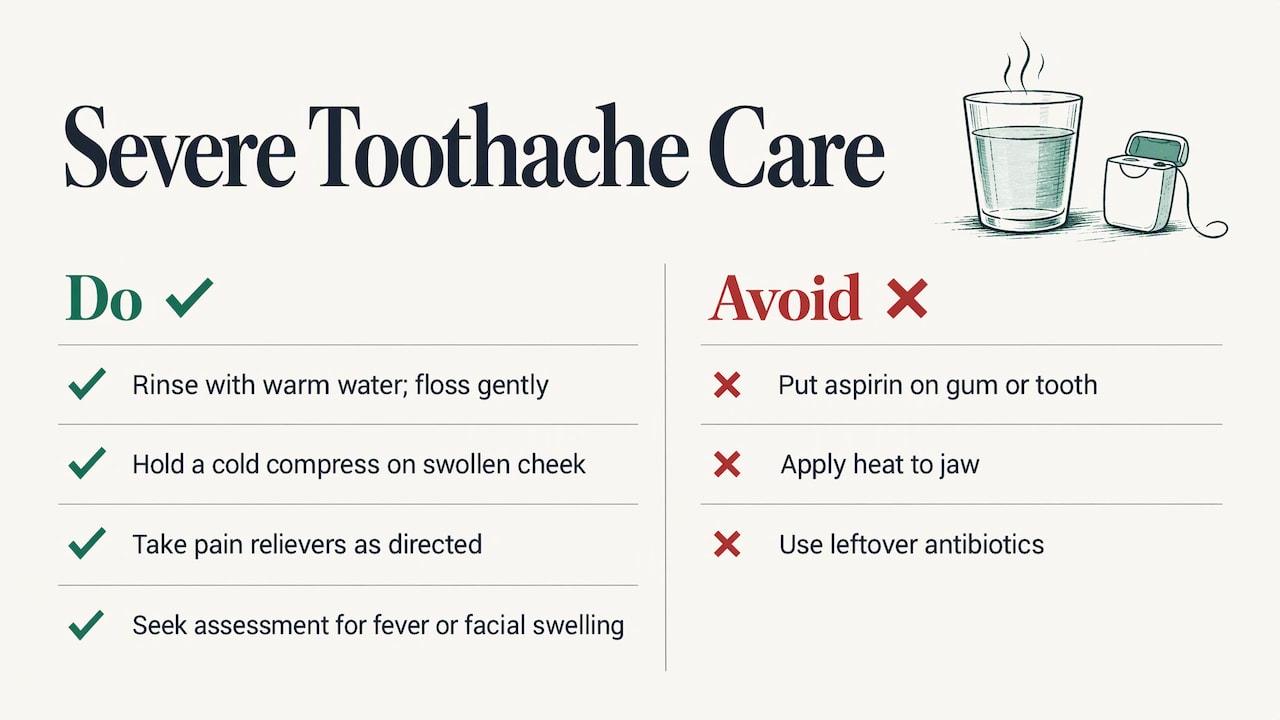
The Cleveland Clinic suggests rinsing with warm water, flossing gently to remove lodged food, and holding a cold compress on the outside of the cheek if it is swollen. Over-the-counter pain relievers can help if you take them as directed on the label. Never place aspirin directly on the gum or tooth, because it can burn the gum tissue.
The Ontario Dental Association adds two useful points. Do not put heat on your jaw, because heat can make things worse. And antibiotics are only for cases with fever or swelling on the outside of the face, which means they need a professional’s assessment first, not a leftover prescription from the cupboard.
Knocked-out permanent tooth
Time matters here. According to the Cleveland Clinic, the dentist has the best chance of saving the tooth if it is back in its socket within an hour. Their steps:
- Pick the tooth up by the crown (the white chewing part), never by the root.
- Rinse the root gently with water. Do not scrub it or remove tissue fragments.
- If you can, push it back into the socket and bite gently on a clean cloth to hold it.
- If you cannot reinsert it, keep it in a container of milk or salty water.
- Get to a dentist as quickly as possible.
This applies to adult teeth. Baby teeth are not put back in. If your child is the patient, our guide to a pediatric dental emergency covers the first minutes in more detail.
Cracked, chipped or broken tooth
Rinse your mouth with warm water, save any pieces you can find, and use a cold compress on the cheek if there is swelling. Avoid chewing on that side. If a sharp edge is cutting your tongue, a small piece of sugar-free gum or dental wax can cover it until you are seen. We explain what happens next in what to do about a chipped, cracked or broken tooth.
Lost filling or crown
Keep the crown if you have it and bring it with you. Do not use household glue. Over-the-counter dental cement from a pharmacy is meant only as a short-term cover until your visit, and the tooth still needs a dentist.
What a Calgary emergency dentist will do
The goal of an urgent visit is to find the source of the problem, relieve pain and stabilize the tooth. A full, permanent repair sometimes follows at a second appointment.
A typical visit starts with questions about when the pain began, what makes it better or worse, and your medical history. Then comes a focused exam and usually an X-ray of the area. From there, depending on the diagnosis, treatment may include:
- Pain relief and calming an infection. The dentist may drain a swelling or clean out the source of the infection. Whether antibiotics are needed is a clinical decision.
- Root canal therapy. When the nerve inside the tooth is infected or inflamed, endodontic therapy removes the damaged tissue and seals the tooth so it can be kept.
- Repairing a fracture. Depending on the break, this can mean bonding, a filling, a crown, or in more serious cases root canal treatment first.
- Replacing or re-cementing a lost restoration. A temporary cover may protect the tooth until a permanent one is made.
- Splinting a loosened or reinserted tooth so it can heal in position.
- Extraction. When a tooth cannot be saved, removing it can stop the pain and the infection. We discuss replacement options afterward.
A good emergency dentist explains what they see, what the options are and what each choice means for the tooth and your budget before starting. If you are not sure why a step is needed, ask.
What an emergency visit costs in Calgary
Alberta dentists have a published reference point. The Alberta Dental Association’s 2026 fee guide for general dentists, effective January 1 to December 31, 2026, lists these items:
| Procedure | Code | 2026 guide fee |
|---|---|---|
| Emergency examination | 01205 | $81.05 |
| Simple extraction | 71101 | $174.55 |
| Surgical extraction | 71201 | $314.75 |
Three things to know when you read those numbers:
- It is a guide, not a price list. Each clinic sets its own fees, so what you pay in Calgary can differ from the guide. Ask the office for an estimate when you call.
- One visit can include several line items. An emergency exam plus an X-ray plus a treatment is a different total from the exam alone. A root canal, a crown or a more complex extraction costs more than the figures above.
- Insurance usually covers part of it. Ask the clinic what it can bill directly to your plan and what you pay up front. Our plain-language explainer on the Alberta Dental Fee Guide and insurance walks through how the guide and your coverage fit together.
We do not publish set prices for individual treatments on our site, so we cannot quote a fee in an article. Call us and we will explain what to expect for your situation.
If dental anxiety is why you have waited
Many people put off urgent care because they are afraid of the dentist, and then arrive in more pain with fewer options. If that is you, you are not alone and you will not be judged here.
The most useful step is simple: tell the office when you call. Explain that you are anxious, what part worries you (needles, sounds, feeling trapped) and that you would like each step explained. The team can then change the pace, pause when you ask and talk through options before anything starts. We also offer sedation dentistry, and you can ask whether it suits your situation and the treatment you need.
How to prepare for the call
A few minutes of preparation makes the appointment faster and gives the dentist what they need.
- Describe the problem clearly. Where is the pain, how long has it lasted, how strong is it, and does it wake you at night?
- Mention swelling, fever or a bad taste. These suggest infection and affect how urgently you should be seen.
- Tell them about injuries. If there was a blow to the head or face, say so.
- List your medications and health conditions. This includes blood thinners, allergies and anything you have taken for pain.
- Bring your insurance details and ask about billing.
- Bring any pieces. A broken tooth fragment or a crown can be useful.
How to lower your risk of a dental emergency
Not every emergency can be avoided, but many begin as something small. Cavities that grow quietly, cracked fillings and gum infections often show up on an exam long before they hurt.
- Keep regular checkups. Our proactive dentistry approach is built around catching problems early and addressing the cause.
- Do not skip cleanings. Regular hygiene visits and teeth cleanings keep gum disease in check.
- Wear a mouthguard for sports. It is among the simplest ways to protect teeth from injury.
- Do not use teeth as tools. Opening packages or cracking ice breaks teeth.
- Treat grinding. If you wake with a sore jaw or worn teeth, mention it at your next visit.
Our perspective
Most dental emergencies we see did not start as emergencies. They started as a small crack, a cavity or a gum problem that nobody could see, and they became urgent when they finally hurt. That is why we look beyond the sore tooth. When someone comes in with pain, our first job is to relieve it and stabilize the situation. Our second is to find out why it happened, so it does not happen again.
We practise whole-body, evidence-based dentistry that aims at root causes, not only symptoms. For an emergency patient that means a clear explanation of what we found, honest options and a plan you understand before treatment begins. We also know that fear keeps people away. Our approach is personal and judgment-free, and sedation is one of the ways we make care more comfortable.
If you are in pain and unsure whether it counts as an emergency, call us. We would rather hear from you early.
Deane
Emergency dental care at Vigée Dental
If you live or work in Calgary and need urgent dental care, our team can assess the problem, relieve your pain and talk through the next steps in a calm, judgment-free setting. Our services include emergency dentistry, root canal therapy, restorative care, sedation dentistry and pediatric dentistry for children.

See our emergency dentistry page or visit vigeedental.ca to contact us. If you are bleeding heavily or having trouble breathing, call 911 first.
FAQ
How do I know if my toothache is an emergency?
Treat it as urgent if the pain is severe, is not controlled by over-the-counter medication, keeps you from sleeping or daily activities, or comes with swelling or fever. Call a dentist the same day. If swelling spreads and affects breathing or swallowing, go to the emergency department.
How much does an emergency dentist cost in Calgary?
The 2026 Alberta Dental Fee Guide lists an emergency exam at $81.05, a simple extraction at $174.55 and a surgical extraction at $314.75. Clinics set their own fees, and X-rays or further treatment add to the total. Ask for an estimate when you call.
Should I go to the ER for a dental problem?
Go to the ER or call 911 for uncontrolled bleeding, a facial injury that affects breathing, or swelling that makes it hard to breathe or swallow. For most other urgent dental problems, such as a toothache or broken tooth, a dentist is the right first call because the ER cannot usually repair teeth.
What should I do if a tooth is knocked out?
Hold it by the crown, rinse the root gently with water without scrubbing, and try to put it back in the socket. If you cannot, store it in milk or salty water. Get to a dentist as fast as you can, ideally within an hour.
Can I get care if I am afraid of the dentist?
Yes. Tell the office about your anxiety when you call so the team can adapt the pace and explain each step. Sedation dentistry may also be an option depending on your treatment, and you can ask about it at the start.
Sources
- Information on Dental Emergencies (College of Dental Surgeons of Ontario)
- Emergency Clinic (University of Toronto Faculty of Dentistry)
- What Is a Dental Emergency and Where To Go for Care (Cleveland Clinic)
- Dental Emergencies (Ontario Dental Association)
- Abbreviated Alberta Dental Fee Guide for General Dentists, 2026 (Alberta Dental Association)