
The classic sign of a cracked tooth is sharp, erratic pain when you chew, often strongest the moment you release the bite, sometimes with a jolt of sensitivity to cold. The tricky part is that a crack can be invisible, the pain can come and go, and even a dentist may need time to find the tooth responsible. If this sounds familiar, the safest move is an exam early, before a small crack becomes a deep one. At Vigée Dental in Calgary, a new patient exam is where that detective work starts.
TL;DR
- The hallmark symptom is sharp, unpredictable pain on biting or when you let go of the bite, often with cold sensitivity.
- Cracks frequently do not show on X-rays or to the naked eye, so a hands-on exam matters.
- Constant or severe pain, facial swelling or fever means calling a dentist right away.
- Early treatment, often a protective restoration over the weakened tooth, improves the odds of keeping the tooth.
- Grinding, clenching, ice and hard foods are common triggers, and most are manageable.
Table of Contents
- The main signs of a cracked tooth
- Why it is hard to tell which tooth hurts
- Early cracks versus advanced cracks
- Common causes
- How a dentist finds a crack in Calgary
- What to do while you wait for your appointment
- Treatment options and why timing matters
- Cracked tooth care at Vigée Dental in Calgary
- Our perspective
- FAQ
- Book your visit
- Sources
The main signs of a cracked tooth
The American Association of Endodontists (root canal specialists) describes erratic pain when chewing, possibly when biting pressure is released, or pain with temperature extremes. The pain may come and go. Here is what that looks like day to day:
- Pain when you bite. A sudden, sharp pain on a particular bite, then nothing for hours or days. StatPearls calls this the most frequently reported symptom.
- Pain when you let go. A fleeting zing as you release the bite. Researchers call it rebound pain. A 2025 mini-review in Frontiers in Oral Health explains that the cracked section flexes and springs back, stimulating the nerve endings inside the tooth.
- Cold or hot sensitivity. In a US practice-based study of 2,858 cracked teeth reported in a 2025 European Society of Endodontology position statement, 45% were symptomatic, and pain to cold (37%) was the most common symptom, ahead of biting pain (16%) and spontaneous pain (11%).
- A feeling that something is stuck. The same Frontiers review lists this, along with dull, vague pain when chewing fibrous food.
- Gum swelling near the tooth. The review also lists gum swelling and sensitivity when biting down.
If cold sensitivity is your main complaint, it has other causes too, which we cover in why teeth get sensitive to cold.
Why it is hard to tell which tooth hurts
Cracked tooth pain is rarely easy to pin down. The endodontists’ teaching material notes patients often have trouble explaining the complaint, and the pain usually does not occur when the tooth is tapped. The European Society of Endodontology adds that early symptoms are poorly localised and can be mistaken for other conditions, and some cracks cause no symptoms at all.
A useful habit: note which side hurts, which foods set it off (hot, cold, sweet, sticky) and whether it hurts on the bite or on release. The New Brunswick Dental Society suggests exactly this to help your dentist reach a diagnosis.
Early cracks versus advanced cracks
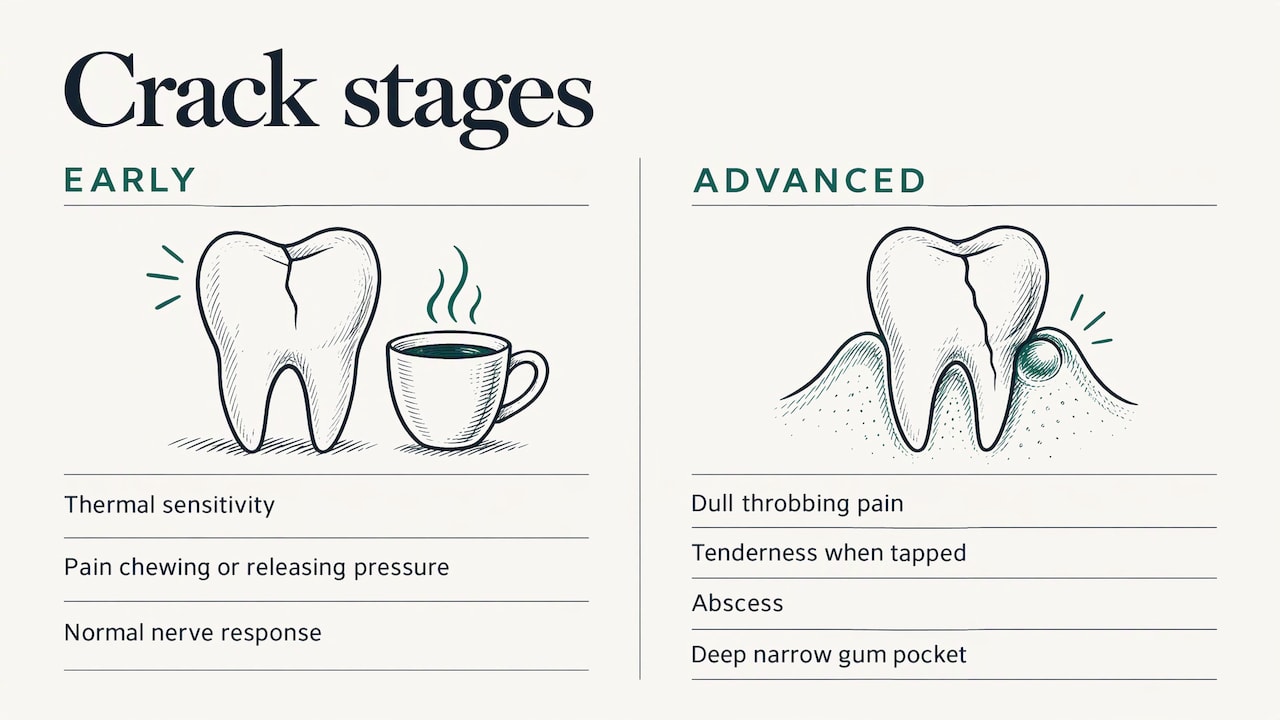
The 2025 position statement describes a progression. Early on, a tooth may show thermal sensitivity and pain when chewing or releasing pressure, while the nerve still responds normally. In more advanced stages you may see dull throbbing pain, tenderness when tapped, an abscess (a pocket of infection) or a deep, narrow pocket along the gum next to one tooth.
StatPearls adds that if the crack reaches the pulp, the nerve centre of the tooth, the pain can turn into a continuous dull ache that worsens with heat and disturbs sleep. At that point a root canal may be needed. Our guide to the signs you need a root canal explains what that pain feels like and what treatment involves.
Common causes
The New Brunswick Dental Society says a cracked tooth most commonly comes from a blow to the mouth or from clenching and grinding. The Ontario Dental Association also lists biting ice, since cold temperature and hard ice can crack teeth and dental work, and advises a mouthguard for sports and not using teeth as tools.
Teeth with large fillings are at higher risk, and so are teeth under constant grinding pressure. If you wake with a sore jaw, read about night guards for teeth grinding.
How a dentist finds a crack in Calgary
Because a crack is a finding rather than a diagnosis, the dentist has to work out what state the tooth’s nerve is in too. The endodontic literature describes several steps:
- Your history. Where it hurts, what triggers it, when it began.
- A bite test. The University of Toronto’s endodontics teaching describes a small tool placed on individual cusps (the tooth’s raised points) while you bite and release. Pain on release is a common finding with a cracked tooth.
- Cold testing. A chilled cotton pellet shows whether the nerve responds normally. A normal response fades immediately once the cold is removed.
- Gum probing. A narrow, isolated deep spot beside one tooth can point to a crack. The Frontiers review links deeper probing to a higher chance of nerve death.
- Light and magnification. Shining light through the tooth helps: it passes through fine craze lines (harmless surface lines in the enamel) but is blocked by a true crack.
- Imaging. The 2025 position statement says only 2% of cracked teeth with living nerves showed the crack on an X-ray. Dentists may take several angles, and 3D imaging is sometimes used when the picture is unclear.
This is why a real exam beats guessing. Calgary patients with unexplained biting pain should not wait for a visible crack to appear.
What to do while you wait for your appointment
- Call a dentist promptly for constant or severe pain, as the Ontario Dental Association advises.
- If breathing through your mouth or cold drinks hurt, the American Association of Endodontists suggests biting gently on clean, moist gauze or cloth until you are seen.
- Do not place aspirin or topical pain ointments on the tooth or gums.
- For swelling, apply a cold compress. Take ibuprofen only as directed by your dentist or pharmacist.
- If a piece breaks off, keep the fragment in cold milk and bring it along.
- Fever or facial swelling needs urgent attention, from a dentist or an emergency department if you cannot reach one.
If the tooth has already chipped or split, our page on what to do with a chipped, cracked or broken tooth walks through the next hours.
Treatment options and why timing matters
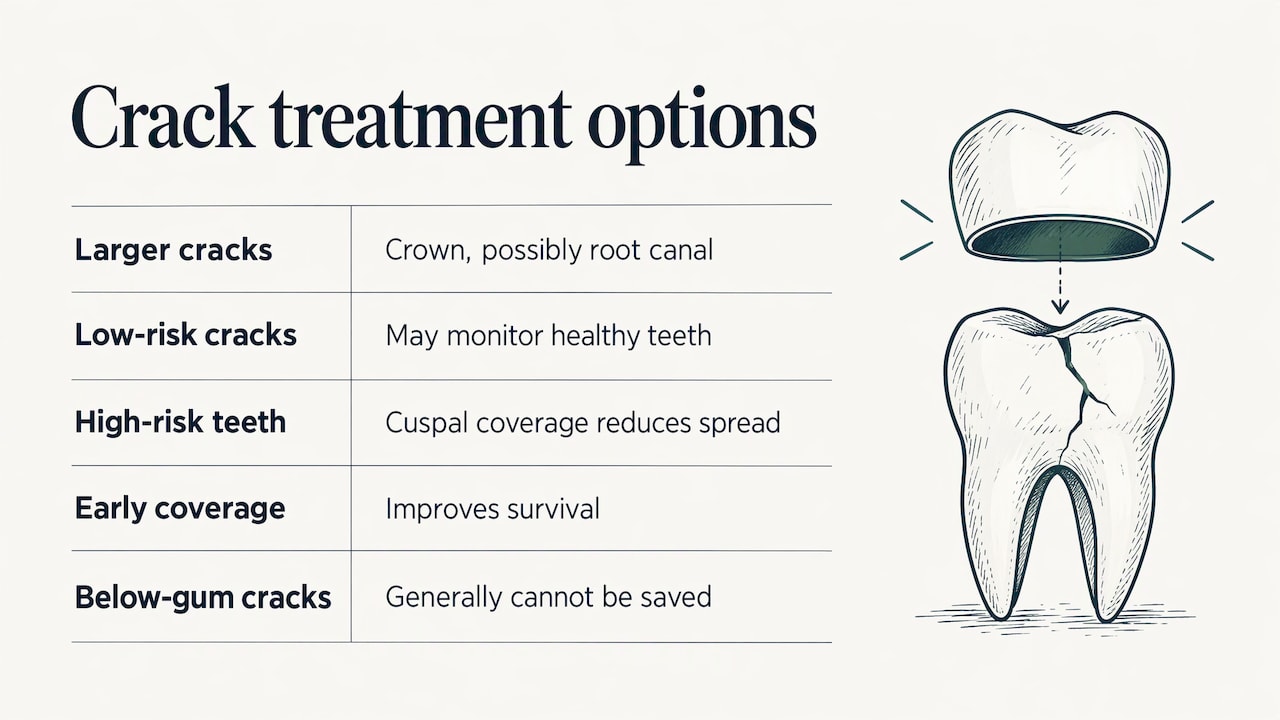
Treatment depends on the size and location of the crack. The Merck Manual notes that an incomplete fracture can often be corrected with a simple filling, while larger ones may need a crown, with or without a root canal. The European position statement says shallow, low-risk cracks in a healthy tooth can sometimes be monitored. High-risk teeth, such as heavily restored teeth or those of patients who grind, warrant active treatment with a restoration that covers the cusps to reduce the chance the crack spreads. It also reports that early management with that kind of coverage improves survival.
The endodontists add that a crack extending below the gum line generally cannot be saved. That is the strongest argument for acting on early symptoms.
Smaller chips and edge damage may be handled with composite bonding. For a tooth damaged by decay or an old filling, our restorative dentistry page covers the options.
Cracked tooth care at Vigée Dental in Calgary
Our approach is conservative and evidence-based: we look for the root cause of a problem, such as grinding, rather than only treating the symptom, and we explain each option without judgment. Dr. Nicole Robins leads the clinic, and our services include emergency dentistry, restorative dentistry, root canal therapy and sedation dentistry for patients whose dental anxiety keeps them away. If you are anxious about a dental visit, tell us when you book so we can plan for your comfort.
On cost, Alberta dentists set their own fees, and the Alberta Dental Fee Guide is the reference most Calgary offices and insurers use as a benchmark. We publish no fixed prices for these services, so we review your treatment plan and costs with you before starting.

Find us at 1035 64 Ave SE, Unit 170, Calgary, or see all our services.
Our perspective
Most cracked teeth we hear about start with a small, easy-to-ignore twinge. People tell themselves it is nothing because it comes and goes. We would rather see you early, when a conservative restoration may be enough, than later when the nerve is involved.
We also look at why the tooth cracked. Clenching, grinding at night and heavy old fillings often explain it, and a whole-body view of your health, stress and habits helps protect the next tooth as well as this one. Proactive care, including regular checkups, is how we aim to catch weak spots before they hurt.
And if the dentist’s chair is the reason you have been putting this off, that is common and we do not judge it. Sedation options and clear communication are part of how we care for patients.
Deane
FAQ
How can I tell if my tooth is cracked?
Look for sharp pain on biting, a zing when you release the bite, and cold sensitivity that comes and goes. Visible cracks are often absent, so only an exam can confirm it. Your dentist uses bite tests, cold tests, gum probing and imaging.
Should I leave a cracked tooth?
No. Cracks can let bacteria reach the nerve, and the endodontic literature treats that as the main risk. Early care gives the best chance of keeping the tooth, so book an exam as soon as you notice symptoms.
Can a cracked tooth cause gum pain?
Yes. Gum swelling near the tooth is a recognised sign, and an advanced crack can cause an abscess or a narrow deep pocket beside the tooth. Swelling or fever needs prompt attention.
My tooth cracked in half. What should I do?
Rinse with water, keep any fragment in cold milk, apply a cold compress for swelling and call your dentist right away. Do not put aspirin on the area. Our emergency dentistry team can see you in Calgary.
Book your visit
If you suspect a cracked tooth, book an appointment at Vigée Dental in Calgary and let us find the cause before it gets worse.
Sources
- Cracked Teeth, American Association of Endodontists
- Cracked Tooth Syndrome, StatPearls
- Cracked tooth syndrome: a diagnostic dilemma, Frontiers in Oral Health
- Position statement on longitudinal cracks and fractures, International Endodontic Journal
- Tooth Troubles, New Brunswick Dental Society
- Dental Emergencies, Ontario Dental Association
- Diagnosis in Endodontics, University of Toronto Faculty of Dentistry
- Fractured, Loosened, or Knocked-Out Teeth, Merck Manual