

Botox is a Health Canada–approved preventive treatment for chronic migraine, which means 15 or more headache days a month, at least 8 of them with migraine features. If that describes your month, it is worth a proper conversation with a clinician who treats the whole jaw, neck and bite picture, not only the head. At Vigée Dental in Calgary, Botox for migraines is one of our therapeutic Botox services, and this guide covers what you need to know before you book: who it is for, how a course of treatment runs, how long it takes to work, what it costs to find out about coverage, and how to care for yourself afterward.
TL;DR
- Botox is approved in Canada to prevent chronic migraine in adults: 15 or more headache days a month, at least 8 with migraine features. It is not a treatment for occasional migraines.
- Expect a course, not a single visit. Relief often builds over the first two or three treatments, and three treatments is the usual fair trial.
- Coverage in Alberta runs through drug plans and special authorization, so ask your doctor and your insurer about criteria before your first appointment.
- Side effects are usually mild, with neck pain the most common. Simple aftercare in the first hours matters.
- We offer Botox for migraines in Calgary alongside TMJ, masseter and trapezius Botox, which suits people whose headaches involve clenching, jaw tension or tight shoulders.
Table of Contents
- Does Botox actually prevent migraines?
- How treatment works and when to expect results
- Why the jaw, neck and bite matter
- Does Alberta cover Botox for migraines?
- Side effects and risks
- Aftercare in the first hours and days
- What a first visit with us looks like
- Is Botox for migraines right for you?
- Promo: book your Botox consultation in Calgary
- Our perspective
- FAQ
- Sources
Does Botox actually prevent migraines?
Botox (onabotulinumtoxinA) is a preventive treatment. It is given on a schedule to reduce how many headache days you have, not taken during an attack to stop one that has started.
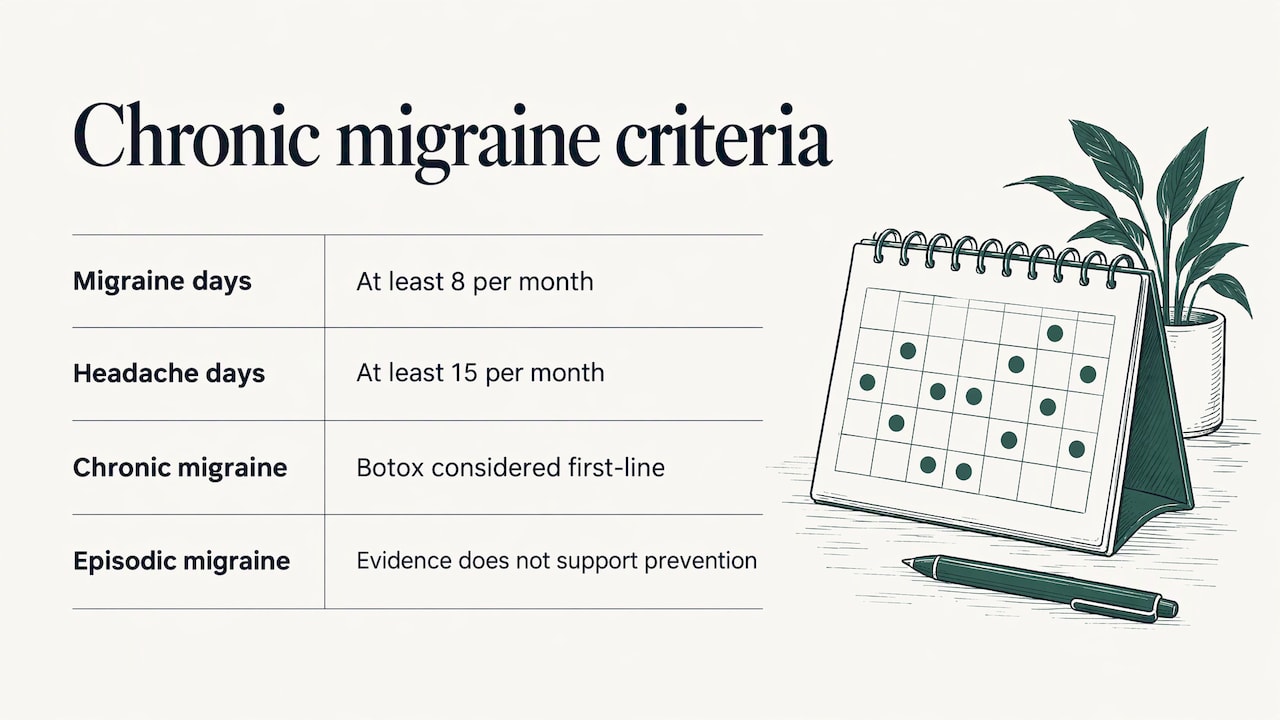
The evidence behind it is strong for one group. The updated Canadian Headache Society guideline, published in 2024 and 2025, recommends that onabotulinumtoxinA be considered a first-line option for chronic migraine, citing high-certainty evidence from the two large PREEMPT phase III trials. The same guideline defines chronic migraine as at least 8 migraine days and at least 15 headache days per month. That is a shift from older guidance that placed Botox later in the sequence of treatments.
The key phrase is chronic migraine. The Ontario workers’ compensation board’s drug committee reviewed the evidence and found it supports Botox for chronic migraine prevention, not for episodic migraine or other headache disorders. If you get a few migraines a month, a different preventive plan will usually fit better, and your family doctor or a neurologist is the right person to talk that through.
Who may be eligible
In practice, you are a candidate if:
- You are an adult.
- You have headaches on 15 or more days a month, and at least 8 of those days have migraine features such as throbbing pain on one side, nausea, or sensitivity to light and sound.
- A physician has confirmed a chronic migraine diagnosis.
A headache diary is the simplest way to show this. Mark each day, note whether it had migraine features, and bring three months of entries to your appointment. It also gives you a baseline, so you can see later whether treatment is working.
How treatment works and when to expect results
Botox for migraine is given as a series of small injections in the muscles of the forehead, temples, back of the head, neck and shoulders. Botox works by temporarily relaxing muscles and by calming the pain signals that feed into a migraine. The dose used for chronic migraine varies between 155 and 195 units, depending on the protocol and your needs.
The appointment itself is quick. The effect is the slow part.
A realistic timeline
Migraine Canada’s partner organization, the Canadian Migraine Society, notes that about half of patients see results after the first procedure, while many do not see results until the third. Their guidance is to commit to three procedures for a fair trial, and if there is even a slight improvement, to continue to five.
That shapes how you should plan:
- First treatment: Treat it as the start of a trial. Keep your diary going.
- Second and third treatments: This is where many people notice the change. Compare your headache days to your baseline, not to how you feel on a single bad day.
- After three treatments: You and your prescriber decide whether the reduction justifies continuing.
The Canadian Headache Society guideline also says there are no long-term safety concerns that warrant stopping in patients who want to continue. If you later go back to an episodic pattern with minimal disability for at least 12 months, it describes a gradual approach: lengthen the interval between treatments and stop if nothing worsens.
Why the jaw, neck and bite matter
Many people with frequent headaches also clench or grind their teeth, carry tension in the jaw and trapezius muscles, or wake with a sore face. These are the muscles a dental team looks at every day. A dentist sees how your teeth wear, how your jaw tracks when you open and close, and where the muscles are overworked.
That is the reason some Calgary patients look for Botox in a dental setting. Our approach at Vigée Dental is whole-body and root-cause focused: we want to understand what is driving your symptoms, not only treat the symptom. Our Botox services cover the areas where headache, jaw and shoulder tension overlap:
- Botox for migraines for chronic migraine prevention.
- TMJ and masseter Botox for jaw pain, clenching and tight chewing muscles. Our guide to how TMJ Botox works and who it helps explains that side in more detail.
- Trap Botox for the trapezius muscles at the neck and shoulders.
If your headaches come with morning jaw soreness, worn teeth or a clicking joint, mention it at your visit. It tells us a lot about where to look.
Does Alberta cover Botox for migraines?
This is the question that decides whether treatment is practical, so it is worth sorting out early. We do not publish a price for migraine Botox, and your out-of-pocket cost depends mostly on your coverage.
Here is what the published sources say:
- Migraine Canada states that Botox for chronic migraine is currently covered under the Alberta government drug plan, and that most private plans and some public plans cover all or part of the cost.
- Common insurance criteria, according to the same page, include a chronic migraine diagnosis and a previous trial of, or side effects from, one or more migraine preventive medications. Some plans also ask for proof that the treatment is working.
- Plans that follow Alberta Blue Cross rules use special authorization. One Alberta group benefits plan explains that Botox approval is subject to Alberta Blue Cross special authorization, with the prescriber completing the form and sending it directly to Alberta Blue Cross.
For comparison, the criteria that Ontario’s WSIB lists for its own formulary are a useful picture of how strict plans can be. They require a physician with headache-management training, and prior trials of at least three oral preventive medications. They also say treatment should stop if there is less than a 50% reduction after two cycles. Those are Ontario rules and do not apply to Alberta plans, but they show why a good diary and clear paperwork matter.
Three steps before you book
- Call your insurer or benefits administrator. Ask whether Botox for chronic migraine is covered, whether special authorization is required, and what documentation they need.
- Gather your history. List the preventive medications you have tried, the doses, how long you took them and what happened.
- Bring your diary and your questions. Your prescriber can then complete any forms with accurate detail.
Side effects and risks
Most people tolerate Botox well, and the most common problems are mild and temporary. The prescribing information for Botox reports, from the PREEMPT trials, that neck pain occurred in 9% of Botox-treated patients versus 3% on placebo. Other reactions included headache (5%), drooping eyelid (4%), muscle weakness (3%), injection site pain (3%) and facial weakness (2%). Worsening of migraine severe enough to need hospital care happened in about 1% of Botox-treated patients, usually within the first week.
Tell your prescriber before treatment if you are pregnant or breastfeeding, have a neuromuscular condition, have had a reaction to a botulinum toxin product, or take medications that affect muscles or blood clotting. If you have trouble swallowing, breathing or speaking, or your vision changes after treatment, get medical care right away.
Aftercare in the first hours and days
Aftercare for migraine Botox is based mostly on clinical experience. The Canadian Migraine Society cautions that there are no studies on pre- and post-treatment protocols, so you should follow the advice of the clinician treating you. The commonly given guidance, from the same source, is:
- Do not lie down or press on your face or forehead for 4 to 6 hours after the injections. If you need to rest, stay propped at an angle of roughly 45 to 90 degrees.
- Wait 24 hours before bodywork such as massage or acupuncture.
- Wait 24 to 72 hours before using a Cefaly neuromodulation device, if you use one.
This is what people usually mean by the “4-hour rule”. Keep your diary going through the whole course, because it is the best way to judge whether treatment is helping.
What a first visit with us looks like
We keep the first conversation practical. We listen to your headache history, ask about jaw clenching, teeth wear and neck and shoulder tension, and look at how your jaw and bite function. We prioritize comfort and a judgment-free environment, which matters if needles make you anxious or you have been frustrated by years of headaches.
If you also have dental concerns, we can look at them in the same practice. Many of our patients combine therapeutic Botox with preventive care, such as a new patient exam and proactive dentistry, so that bite problems, worn teeth or gum health are not left behind.
Is Botox for migraines right for you?
A quick self-check:
| Your situation | What it suggests |
|---|---|
| 15 or more headache days a month, 8 or more with migraine features | You may meet the approved criteria for Botox |
| A few migraines a month | Talk to your doctor about other preventive options first |
| Jaw clenching, worn teeth, tight shoulders along with headaches | Worth a bite and muscle assessment |
| Tried and stopped other preventives | Bring that history, as plans often ask for it |
| Needle anxiety | Tell us in advance so we can plan for your comfort |
Promo: book your Botox consultation in Calgary
If you meet the criteria above, or you are not sure and want a clear answer, we are happy to see you. Vigée Dental offers Botox in Calgary, including Botox for migraines, TMJ and masseter Botox and trap Botox, in a welcoming clinic led by Dr. Nicole Robins. Bring your headache diary and your medication history.

If you also want to look at preventive care or your smile, you can see everything we offer on our services page.
Our perspective
Headaches rarely start and end in the head. When someone tells us they have constant headaches, we also look at how they clench, how their jaw moves, how their teeth wear and where their shoulders hold tension.
That is why we practise whole-body, evidence-based dentistry: we want to address the root causes, not only the symptom. For chronic migraine, the evidence supporting Botox is strong, and the Canadian Headache Society now puts it among the first-line options. For the right adult, it can be a meaningful step.
We want you to feel comfortable and unhurried at every visit, including if you are anxious about needles. You deserve a clear plan, plain answers and a team that treats your symptoms seriously.
Deane
FAQ
How much does Botox for migraines cost in Calgary?
We do not publish a price for migraine Botox on our site, and the cost depends on your dose and your coverage. Many people pay little or nothing out of pocket through a public or private drug plan, so check coverage with your insurer first.
Does Alberta Health Care cover Botox for migraines?
Migraine Canada states that Botox for chronic migraine is currently covered under the Alberta government drug plan. Criteria apply, commonly a chronic migraine diagnosis and prior preventive medication trials. Ask your doctor and insurer what your plan requires.
How long does Botox take to work for migraines?
Some people feel a difference after the first treatment, but many need three. The Canadian Migraine Society describes three procedures as the usual fair trial. Keep a headache diary so you can compare your days before and after.
What is the 4-hour rule for Botox?
It is the advice to avoid lying down or pressing on the treated area for 4 to 6 hours afterward. The Canadian Migraine Society’s guidance is to stay propped at roughly 45 to 90 degrees if you need to rest. Follow the instructions your clinician gives you.
Does Botox help every kind of migraine?
The evidence supports it for chronic migraine in adults. The Ontario drug committee’s review found it was not supported for episodic migraine or other headache disorders. A doctor can help you work out which category you fall into.
Sources
- Updated Canadian Headache Society Migraine Prevention Guideline
- BOTOX for Migraine: Coverage and Access in Canada, Migraine Canada
- Canadian Migraine Society Migraine Treatment Guide
- WSIB drug formulary listing decision, botulinumtoxinA
- BOTOX prescribing information highlights
- ASEBP drug coverage and special authorization